
Günter Grass – the life, work and legacy of the German Nobel Prize winner
- Damian Brzeski

- 3 hours ago
- 10 min read
Günter Grass is a figure who cannot be placed in a single box – a Nobel Prize winner, the conscience of the nation and a "difficult" son of Gdańsk.
His work is a constant journey through the dark recesses of history, where magical realism intertwines with brutal truths about guilt and memory. Discover the story of the man who gave the world Oskar Matzerath and forever changed the literary map of Europe.

Who was Gunter Grass?
When we speak of Grass, we rarely use simple definitions. He was not only a writer or a sculptor, but above all, an outstanding artist from the borderlands, who turned the peripheral town of Wrzeszcz into the center of the literary universe.
His "black, playful fairy tales" revealed the forgotten face of history, and he became a moral compass for many, albeit often with a cracked lens.
Throughout his life, the writer practiced a specific "crawdaddying" – looking back in order to be able to take a step forward and scratch the healed wounds of collective memory.
Biography of Günter Grass
The Nobel Prize winner's life is a ready-made script for a film, full of twists and turns, painful secrets, and complex relationships. To understand his literature, we must first examine the path he traveled—from a small shop in Wrzeszcz to the world's leading salons.
Childhood and youth in the Free City of Danzig
He was born on October 16, 1927 in a reality that no longer exists – in the Free City of Danzig .
He grew up at Labesweg 13 (today Lelewela), where in his parents' grocery store, amidst the smell of kerosene and exotic spices, he absorbed the atmosphere of a multicultural melting pot.
His origins were the best proof of this: his father was a German Protestant, his mother was Kashubian and Catholic.
It was this tension between identities that shaped the young Günter, a student at the Conradinum in Wrzeszcz, who later poured these experiences into the pages of his novels.
Service in the Waffen-SS and subsequent confession
For decades, biographies remained silent about one key fact, offering a version of auxiliary service. Only in 2006, in the acclaimed "Peeling an Onion," did the writer drop a bombshell: at 17, he joined the 10th SS Panzer Division "Frundsberg."
He attributed this to a youthful desire to escape from the stuffy home and the influence of propaganda that painted the SS in elitist colors.
This confession shocked public opinion, calling into question the moral authority of someone who for years held others accountable for the Nazi past.
Private life and family relationships
In private, Grass built relationships as intense as his prose. His family life was complex and multi-layered:
First marriage (1954–1978): With the dancer Anna Schwarz, with whom he had four children (twins Franz and Raoul, Laura and Bruno).
Informal relationships: During periods of separation, he became the father of two daughters (Helene and Nele) from two different relationships.
Second marriage (since 1979): He married the organist Ute Grunert, who brought two sons into the family from her previous marriage.
The result was a fascinating, multi-child "patchwork" structure – eight children in total – which later became the inspiration for the novel "The Box".

Gdańsk as an ideal creative space
For Grass, Gdańsk was never merely a backdrop. The city functions in his fiction as a fully-fledged, capricious character that lives, breathes, and shapes the fates of its inhabitants.
The city of childhood and literary inspiration
He recreated the topographyof Wrzeszcz with incredible precision, leading the reader from the cemetery in Zaspa to the port quays.
It is a border space where the Polish element clashed with the German and Kashubian, creating a unique atmosphere conducive to the grotesque.
It was in this melting pot that Grassian magical realism was born, in which an ordinary grocery store became the center of the universe.
The Günter Grass Monument and its symbolism
If you visit Wrzeszcz in Gdańsk, you will come across an unusual bench in Wybicki Square, the history of which is as interesting as the sculpture itself:
2002: The sculpture of Oskar Matzerath with a drum was unveiled. The writer's figure was placed in storage, in accordance with his wish to be installed only after his death.
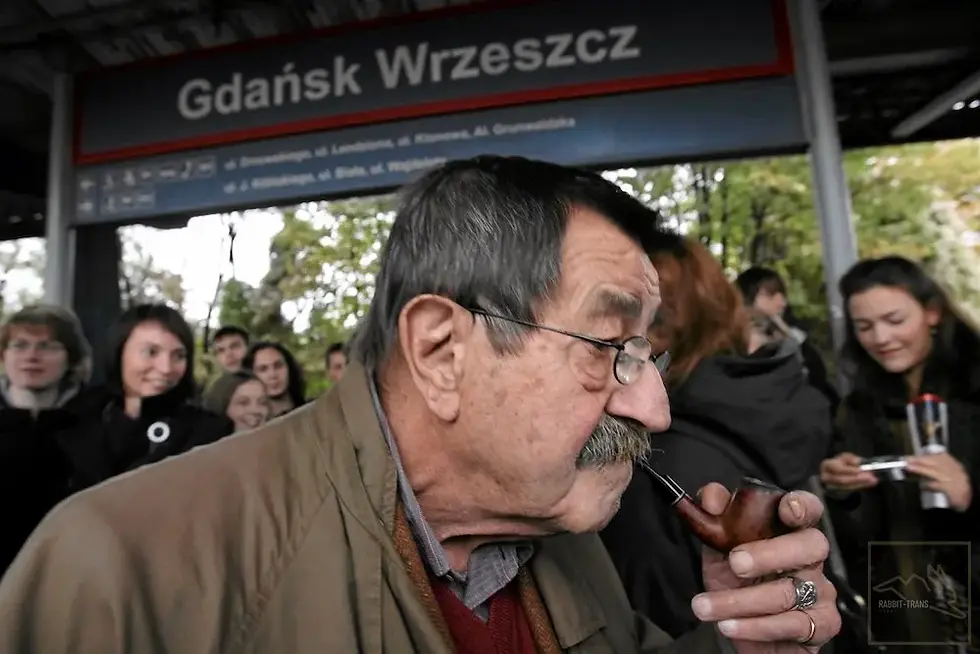
2015: A year after the Nobel Prize winner's passing, a figure of Grass with a pipe was "attached" to the Oscar.
Setting: The writer has a book with a snail on his lap, and next to it is a fountain with a statue of Tulli Pokriefke.
Honorary citizenship and relations with Gdańsk
The writer's relationship with his hometown wasn't always a bed of roses. Although he was awarded the title of Honorary Citizen of Gdańsk in 1993, this gesture was an act of difficult reconciliation.
The controversy returned with a vengeance after his service in the SS was revealed, when even Lech Wałęsa threatened to surrender his passport.
Despite these storms, Grass remained a symbol for the people of Gdańsk of regaining the memory of the multicultural past of this place.
The Gdańsk Trilogy – Grass's most important work
It was this series of novels that defined Grass as a world-renowned author. The trilogy is a masterful study of the decline, guilt, and loss of a small homeland.
Title and year of publication | The main character | Symbolism and meaning |
The Tin Drum (1959) | Oskar Matzerath | The drum as a tool of rebellion against adults and the emerging Nazism. Oskar is a perspective "from the floor." |
Cat and Mouse (1961) | Joachim Mahlke | Adam's apple ("mouse") as a complex that the hero tries to hide behind a mask of heroism and war decorations. |
Dog Years (1963) | Walter Matern and Eduard Amsel | The dog Prinz (Hitler's favorite) as a metaphor for the inescapable guilt that haunts the heroes after the war. |
The Tin Drum and the Figure of Oskar Matzerath
The debut was like a lightning bolt. Oskar Matzerath, a boy who decides to stop growing on his third birthday, is one of the most extraordinary narrators in literary history.
From the perspective of the "floor," he exposes the hypocrisy of adults. His glass-shattering voice is a devastating force aimed at the false facades of the bourgeois world.
Cat and Mouse – Youth in the Shadow of Nazism
In this novella, Grass takes us back to Wrzeszcz to tell us about Joachim Mahlke.
The drama takes place on the wreck of a Polish minesweeper, which becomes the last refuge of a boy trying to escape the pressures of society (the "cat") that preys on his otherness.
Dog years – war and German-Kashubian identity
The trilogy concludes with a story about the complicated friendship between a German and a half-Jew. The titular "dog years" refer to the dark era of Nazism, and history shows that no matter how fast we try to run, the past will always catch up with us.
Other important literary works
While the Gdańsk Trilogy is the most well-known, Grass's oeuvre encompasses much more. The writer was not afraid to experiment with form and explore topics others chose to remain silent about.
Crawling – the tragedy of Wilhelm Gustloff
The 2002 novella, "Im Krebsgang," is a bold take on the tragedy of the Wilhelm Gustloff.
Grass shows here the mechanism of silence about their own suffering by the generation of perpetrators, which paradoxically opened the way for the appropriation of history by far-right movements.
My Century – The History of the 20th Century in 100 Stories
Imagine a mosaic of one hundred short stories—one for each year of the past century. In this collection, Grass gives voice to workers, soldiers, and intellectuals, creating a subjective chronicle of an era of war, progress, and moral decay.
Turbot – a fairy-tale critique of patriarchy
In this monumental novel, the author employs fairy tale conventions. The talking fish, the titular Turbot, supports patriarchy for centuries, only to finally face a feminist tribunal.
The story is told through the lens of a kitchen and nine cooks, making food an alternative center of history.
Meeting in Telgte – an allegory of Group 47
In "Meeting in Telgte" Grass creates an allegory of the post-war Group 47, moving the action to the times of the Thirty Years' War.
Poets meet in a small town to save language and literature in the face of the collapse of the country – much like German writers did after 1945.
The Box and Other Late Novels
"The Box" is an intimate return to family matters. The narrative, entrusted to the writer's children, revolves around an old camera that captures not what is, but what was or is yet to come—a beautiful symbol of the power of imagination.
Essays and journalism by Günter Grass
Grass was never a writer confined to an ivory tower. His voice, often controversial, resonated loudly in public debates, both jarring and thought-provoking.
Peeling the Onion – An Autobiography and Coming to terms with the Past
The metaphor of peeling an onion, which brings tears to the eyes as subsequent layers are revealed, was used by the writer to work with his own memory.
It was in this volume of memoirs that he confessed his youthful fascination with Nazism – an act of courage, but also a final shedding of the mask.
What Must Be Said – A Controversial Voice on Israel
In 2012, a poem criticizing the policies of Germany and Israel caused an international scandal, ending with the writer being declared persona non grata in Israel.
Grass defended himself, pointing out his right to criticize governments, but accusations of reversing the victim-victimizer roles cast a shadow over his image.
Grimm's Wörter and From the Snail's Diary – Reflections on Language and Politics
Two key essays are worth mentioning:
From the Snail's Diary: The snail becomes a symbol of the slow but necessary progress in democracy.
Grimms Wörter: A declaration of love for the German language, interwoven with the story of the Brothers Grimm and the biography of the author.

Nobel Prize and other awards
The crowning achievement of his creative career was 1999, when the eyes of the entire literary world turned to Stockholm.
The 1999 Nobel Prize in Literature
The Academy awarded him the prize because his "playful, dark fables portray the forgotten face of history." This was not only a recognition of his literary craft but also a confirmation of his status as the most important German writer of the second half of the 20th century.
The significance of the award for the reception of Grass's work
The Nobel Prize for Grass had a symbolic dimension – it closed the 20th century in literature and emphasized the importance of coming to terms with the past ( Vergangenheitsbewältigung ).
The Nobel Prize also strengthened the position of borderland literature, proving that stories from Gdańsk have a universal dimension.
Grass as an artist and social activist
But Günter Grass was more than just the written word. He was a total artist, for whom the chisel and brush were as important as the pen, and for whom social engagement was a civic duty.
Sculptor, graphic artist, and founder of the Daniel Chodowiecki Foundation
He often designed the covers of his books himself, and motifs of fish, rats and snails became his visual signature.
In 1992, he founded the Daniel Chodowiecki Foundation, supporting collaboration between Polish and German artists, referring to the 18th-century Gdańsk graphic artist as a patron of cultural symbiosis.
Political involvement and cooperation with the SPD
As a "voicing citizen," he actively supported the SPD and Willy Brandt in the 1960s and 1970s. He was a staunch advocate of Ostpolitik —a policy of rapprochement with Poland and recognition of the Oder-Neisse border.
A role in Germany's coming to terms with the past (Vergangenheitsbewältigung)
His work became the moral foundation of the new Europe. Grass literally "drummed out" what his parents' generation had sought to conceal under a rug of silence.
Despite the controversy, his contribution to building civil society remains invaluable.
The Legacy of Günter Grass
The writer has passed away, but his work lives on – in museums, on cinema screens and in the minds of future generations of readers.
Gunter Grass House in Lübeck – museum and archive
In Lübeck, where he spent his final years, there is the Günter Grass-Haus. This modern center allows you not only to view the manuscripts but also, thanks to VR technology, literally enter the world of his imagination.
Film adaptations, including Volker Schlöndorff's The Tin Drum
Grass's prose has been frequently used in cinema. Among the most important adaptations are:
The Tin Drum (1979): Directed by Volker Schlöndorff (Oscar and Palme d'Or).
The Toad's Oath (2005): Directed by Robert Gliński (with Krystyna Janda).
Cat and Mouse (1967): Dir. Hansjürgen Pohland.
Influence on German and European literature after 1945
Grass freed the German language from its rigid pathos, introducing a sensuality and plebeianism. His influence can be seen in the works of such giants as Salman Rushdie and John Irving.
And most importantly, he proved that local identity can be the key to understanding universal truths about humanity.

FAQ - Frequently asked questions about the life and work of Günter Grass
Below you will find concise answers to key questions about the German Nobel Prize winner, his complicated biography, and his connections with Gdańsk.
Who was Günter Grass? : He was an outstanding German writer, Nobel Prize winner, sculptor and graphic artist, born in Gdańsk, known for touching on difficult historical topics.
For what did Günter Grass receive the Nobel Prize? : He received it in 1999 for his lifetime achievements, and the justification stated that his "playful black fables portray the forgotten face of history."
What are Grass's most important books? : His most famous works include The Tin Drum , Cat and Mouse , Dog Years (The Gdańsk Trilogy), and Crawdad .
Did Günter Grass serve in the SS?: Yes, in 2006 in his autobiography "When Peeling an Onion" he confessed that as a 17-year-old he was drafted into the 10th SS Panzer Division "Frundsberg".
What does the Gdańsk Trilogy consist of? : It is a cycle of three works set in Gdańsk: the novel The Tin Drum , the short story Cat and Mouse , and the novel Dog Years .
Where in Gdańsk did Günter Grass live?: The writer grew up in the Wrzeszcz district (formerly Langfuhr) at Labesweg 13, now Lelewela Street.
Who is Oskar Matzerath? : He is the main character of The Tin Drum , a boy who decided to stop growing on his third birthday so as not to participate in the adult world.
Where is the monument to Günter Grass? : The monument in the form of a bench with the writer and Oskar Matzerath is located at Wybicki Square in the Wrzeszcz district of Gdańsk.
What were Grass's connections with Poland? : He was born in Gdańsk, his mother was Kashubian, and he politically supported Polish-German reconciliation and the recognition of the Oder-Neisse border.
Why was Grass criticized in Israel?: In 2012, he published a poem criticizing Israel's policy towards Iran, for which he was declared persona non grata in that country.
Was Grass an honorary citizen of Gdańsk? : Yes, he was awarded this title in 1993, although it sparked renewed controversy after his SS service was revealed in 2006.
What did Grass do apart from literature? : He was an active visual artist; he created graphics, sculptures and often designed the covers of his books himself.
What is the book Crawdad about ?: This work deals with the sinking of the Wilhelm Gustloff and is an attempt to deal with the issue of German victims of the war.
What does Grass's concept of "crawfish walking" mean? : It is a metaphor for looking back and analyzing the past, which is necessary to understand the present and move forward.
Where can you see Grass's manuscripts and artwork? : The largest collections are located in the Günter Grass House (Günter Grass-Haus) in Lübeck.
When and where did Günter Grass die? : The writer died on April 13, 2015 in Lübeck at the age of 87.


Comments