
When are the busiest departure times from Polish airports? When should I fly to avoid queues at the gate?

Record passenger numbers mean one thing: the capacity of Polish airports is being tested to the limit.
Understanding how takeoff waves (accumulation of takeoffs in a short period of time) work is the easiest way to avoid stress and long lines at security.
The following report analyzes the daily cycles of Poland's largest airports. Terminal peaks (congestion at security) typically occur 90 minutes before the departure times listed in the tables.
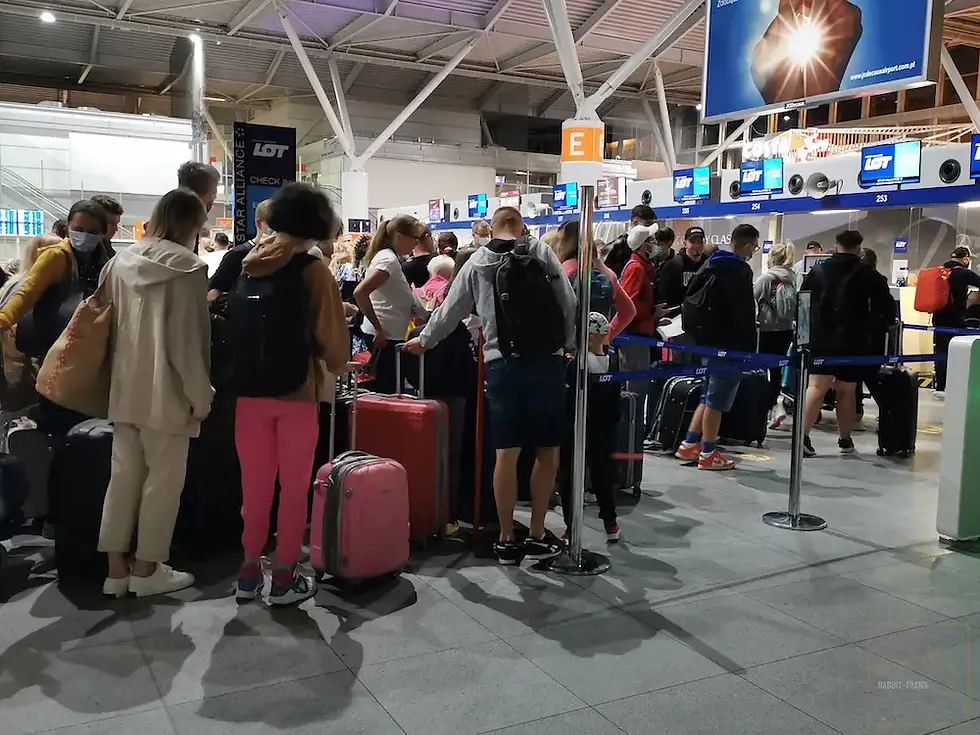
Warsaw Chopin Airport (WAW)
Warsaw operates in a wave (hub) system. Flights from the regions land, passengers transfer to onward flights, and then a mass departure occurs.
This causes periods of relative calm to alternate with moments of terminal paralysis. During these periods, the infrastructure (security, passport control, access) is at maximum capacity.
Rush Hour: Departures from Warsaw
The most difficult moment is the early morning (European wave) and midday (transatlantic wave).
It is worth paying attention to the accumulation between 2:00 and 3:00 p.m., when planes reinforced by earlier arrivals take off.
Peak Departure Schedule – Chopin Airport (WAW)
Time Window | Movement Characteristics and Key Directions | Recommendations for Passengers |
06:00 – 07:45 | Main Morning Wave. Absolute daily peak. Mass departures to major European capitals (London, Paris, Frankfurt, Amsterdam) and domestic flights (Gdańsk, Wrocław, Kraków). Holiday charter flights depart. | CRITICAL. Arrive at the airport at least 2.5–3 hours before departure. Long lines at security checkpoints. |
10:15 – 12:00 | Transatlantic Wave. Departures to the US (New York JFK, Chicago, Newark) and Canada (Toronto), and a second European wave (Copenhagen, Brussels). | Increased traffic in the passport control zone. Passengers on flights to the US are undergoing additional screening. |
14:30 – 16:45 | Afternoon/Asian Peak. Departures to the Middle East (Dubai, Doha), Asia (Seoul, Tokyo), and the afternoon European wave (Prague, Budapest, Riga). | Peak business returns. Crowded business lounges. |
22:15 – 23:00 | Last Evening Wave. Late departures to Georgia (Tbilisi), Israel (Tel Aviv), and delayed European rotations. | Less traffic, but limited service (fewer open checkpoints). |
Rush Hour: Arrivals to Warsaw
The "southern wave" (12:30–1:30 p.m.) is critical. This is when passengers from domestic and transatlantic flights converge, placing a significant strain on the baggage handling system.
Peak Arrivals Schedule – Chopin Airport (WAW)
Time Window | Movement Characteristics and Key Directions | Logistical difficulties |
08:30 – 09:45 | Morning Arrival Wave. Aircraft staying overnight at external airports are returning to base. Domestic and near-European destinations dominate. | Taxis are in high demand. The public area of the arrivals hall is crowded. |
12:30 – 13:45 | South Summit. Spectacular accumulation. Landings from: Gdańsk, Kraków, Rzeszów, Munich, Amsterdam, Toronto, New York, Chicago. | Maximum capacity of the baggage sorting area. Waiting time for your suitcase may be longer. |
16:00 – 17:30 | Afternoon European Wave. Returns from Western hubs (Frankfurt, London, Paris) and regional cities. | Airport traffic overlaps with peak city traffic. Difficult airport exit. |
21:30 – 23:00 | Nighttime Descent Wave. Return of the entire base fleet for the night. Landings every 2-3 minutes. | Very crowded at the baggage carousels. Passengers congregate in the exit area. |
Krakow-Balice (KRK)
Balice is unique in that it's dominated by low-cost airlines (Ryanair, Wizz Air) and tourist traffic. To make four daily rotations, the planes must take off very early.
That's why the terminal gets crowded as early as 4:00 a.m. Frequent fog is an additional risk factor.
Rush Hour: Departures from Krakow
The " Krakow dawn " is crucial. Between 5:45 and 7:15 a.m., departures peak, generating the longest lines at security checkpoints throughout the day.
Peak Hour Departure Schedule – Kraków Airport (KRK)
Time Window | Movement Characteristics and Key Directions | Operational Notes |
05:45 – 07:15 | The Great Morning Wave (LCC). Massive takeoffs for Ryanair and Wizz Air bases. Destinations: Great Britain (Bristol, London), Scandinavia, Italy, and connections to hubs (Warsaw, Frankfurt). | EXTREME CONSUMPTION. Recommended arrival 2.5 hours before departure. Risk of the longest lines of the day. |
10:45 – 12:45 | Morning Wave. Holiday departures and second rotation. Destinations: Paris Beauvais, Catania, Dubai, Manchester, Shannon. | A large proportion of passengers with checked baggage (holidays, emigration), which burdens the check-in desks. |
14:50 – 16:40 | Afternoon Wave. A mix of traditional and low-cost airlines. Departures to: Zurich, Vienna, Malaga, Dublin, Valencia, Bilbao. | Increased business traffic. SWISS and Austrian Airlines flights. |
20:30 – 22:00 | Evening Departures. Last connections to the UK and Ireland, plus flights to overnight hubs. | Moderate intensity, usually a calmer check-in process. |
Rush Hours: Arrivals to Krakow
Peak Arrivals Schedule – Kraków Airport (KRK)
Time Window | Movement Characteristics and Key Directions |
09:30 – 11:00 | Returns from the first wave at home and near abroad. |
12:00 – 13:30 | Arrivals from large European hubs (Amsterdam, Munich) and holiday destinations. |
15:30 – 17:30 | Afternoon tourist rush. Arrivals from the UK and Italy. |
22:30 – 00:30 | Night Return Wave. A very intense period. Landings of base aircraft returning from Spain, Portugal, Italy, and Greece are often delayed. |
Gdansk Airport (GDN)
Gdańsk operates on a rhythm of connections with Scandinavia (worker traffic) and transfer hubs. The day is clearly divided into busy mornings and evenings, with a quieter midday.
Rush Hours: Departures from Gdańsk
The morning (5:30–7:30) is the moment when a dozen or so planes take off in a short time to Norway, Sweden, Denmark and the hubs (Warsaw, Frankfurt).
Peak Departure Schedule – Gdańsk Airport (GDN)
Time Window | Movement Characteristics and Key Directions | Infrastructural Context |
05:30 – 07:30 | The Great Scandinavian and Hub Wave. Dominant destinations: Oslo, Copenhagen, Stockholm, Stavanger. Additional flights to hubs: Warsaw (LOT), Frankfurt (Lufthansa), Amsterdam (KLM). | The busiest airport in 24 hours. 12-13 planes take off in a 90-minute window. Efficient security checks are required. |
11:00 – 13:00 | Southern Wave. Holiday flights (Italy, Spain) and second rotation to hubs. | Less business passengers, more families and tourists. |
5:00 p.m. – 7:30 p.m. | Afternoon Peak. Evening departures to the UK (London, Leeds) and southern tourist destinations (Malta, Cyprus). | Increased traffic in the food court and duty-free shops. |
Rush Hours: Arrivals to Gdańsk
Peak Arrivals Schedule – Gdańsk Airport (GDN)
Time Window | Movement Characteristics and Key Directions |
09:00 – 10:30 | Returns from morning domestic flights and from Copenhagen (SAS). |
5:00 p.m. – 9:00 p.m. | Main Return Wave. A series of landings every fifteen minutes: Copenhagen, Oslo, Hamburg, and charters from the south (Hurghada, Paphos). |
23:00 – 00:30 | Night Landings. Arrivals of the latest Wizz Air rotations (e.g. from London, Reykjavik) and a KLM night connection from Amsterdam. |
Katowice-Pyrzowice (KTW)
Pyrzowice is the center of Polish charter traffic. The airport operates 24/7, with no curfew. During the summer season, peak operations often occur at night.
Rush Hour: Departures from Katowice
A unique feature of Katowice is the "night wave" (01:00–04:00), serving departures to Turkey and Egypt.
At 06:05, charter and scheduled traffic overlap (Lufthansa, Wizz Air), which is a critical moment for capacity.
Peak Hour Departure Schedule – Katowice Airport (KTW)
Time Window | Movement Characteristics and Key Directions | Passenger Specifics |
01:00 – 04:00 | Night Charter Wave. Departures to Turkey (Antalya, Bodrum), Egypt (Hurghada, Marsa Alam, Sharm El Sheikh) and Dubai. | Large number of families with children and non-standard luggage (strollers, diving equipment). Extended check-in times. |
05:30 – 07:15 | Mixed Wave (LCC + Business). Wizz Air and Ryanair departures (Dortmund, London, Athens) and Lufthansa (Frankfurt) and LOT (Warsaw) network connections. | The tail end of the charter wave overlapped with regular traffic. Very crowded in the terminal. |
12:00 – 15:30 | Afternoon Wave. Second wave of charters and scheduled connections to Brussels, Milan, Tenerife, and Abu Dhabi. | Intensive turnover in airport parking lots. |
Rush Hours: Arrivals to Katowice
Peak Arrivals Schedule – Katowice Airport (KTW)
Time Window | Movement Characteristics |
04:00 – 06:00 | Returning overnight charters from the Mediterranean. |
10:00 – 12:00 | Arrivals from Western Europe (Dortmund, Eindhoven) and morning holiday rotations. |
21:00 – 01:00 | Evening Accumulation. Mass returns from vacation and evening Wizz Air flights. |
Wroclaw Airport (WRO)
Wrocław combines strong business and holiday traffic. 6:00 a.m. is critical, as flights departing for major European hubs (Munich, Frankfurt, Warsaw) simultaneously require rapid processing of large numbers of passengers.
Rush Hours: Departures from Wrocław
Peak Departure Schedule – Wrocław Airport (WRO)
Time Window | Movement Characteristics and Key Directions |
05:50 – 07:00 | Main Business Wave. The key moment of the day. Departures to hubs: Munich, Frankfurt (Lufthansa), Warsaw (LOT) and Ryanair bases: London, Oslo, Malaga. |
10:30 – 12:00 | Morning Wave. Second rotation to hubs (Frankfurt) and holiday flights (Alicante, Zadar, Malta). |
14:30 – 17:00 | Afternoon Summit. Departures to Italy (Bari), the UK, and reconnections to Warsaw. |
Rush Hours: Arrivals to Wrocław
Peak Arrivals Schedule – Wrocław Airport (WRO)
Time Window | Movement Characteristics |
12:00 – 13:30 | Arrivals from European hubs feeding afternoon business meetings. |
18:00 – 21:00 | The Great Evening Wave. Accumulation of landings from the UK (Bristol, Dublin), Italy (Bari, Bergamo) and hubs (Warsaw, Gdańsk). |
22:30 – 23:30 | Night landings from Dublin and southern Europe. |
Poznań-Ławica (POZ)
Poznań is characterized by a "jerky" rhythm – periods of quiet alternate with moments of high traffic. Low-cost airlines and charter flights dominate the city.
Rush Hours: Departures and Arrivals
Peak Hour Departure Schedule – Poznań-Ławica (POZ)
Time Window | Movement Characteristics and Key Directions |
06:00 – 07:00 | Start of the Day. Ryanair/Wizz Air base departures and morning arrival to Warsaw (LOT). |
09:15 – 11:30 | Mid-morning (Holiday) Peak. Very busy block. Departures to: Bari, Marsa Alam, Malta, Edinburgh, London (Stansted and Luton). |
18:00 – 20:00 | Evening Wave. Mainly departures to Great Britain and Ireland. |
Peak Arrivals Schedule – Poznań-Ławica (POZ)
Time Window | Movement Characteristics |
14:00 – 15:30 | Arrivals from hubs (Warsaw, Frankfurt) and London. |
00:00 – 03:15 | Night Returns. Poznań's specificity is the very late arrivals of charter flights (e.g., from Dubai, Turkey) and LCC flights (Lisbon). |
Warsaw-Modlin (WMI)
Modlin serves exclusively Ryanair. The terminal operates in a pulsating manner, filling up with passengers momentarily before the wave of departures, only to empty out again shortly afterward.
Rush Hours: Departures and Arrivals
Peak Hour Departure Schedule – Warsaw-Modlin (WMI)
Time Window | Movement Characteristics and Key Directions | Risk |
05:35 – 07:20 | Massive Morning Takeoff. Departures to: Malta, Bergen, Madrid, Helsinki, Milan, London. | Very High. Small terminal, crowded at security checkpoint. |
10:20 – 13:15 | Second Rotational Wave. Departures to: Sharjah, Rome, Palermo, Tenerife. | Moderate. |
17:45 – 20:15 | Evening Wave. Tirana, Malta, Chisinau, Milan, Brindisi. | High. The terminal is full of departing and arriving passengers. |
Peak Arrivals Schedule – Warsaw-Modlin (WMI)
Time Window | Movement Characteristics |
12:00 – 13:20 | Southern arrivals: Malta, Dublin, Paphos, Bucharest. |
22:30 – 01:20 | Nighttime Return Rush. A very busy time. Landings from: Tirana, Chisinau, Bergamo, Malta, Tenerife, Brindisi. |
Rzeszów-Jasionka (RZE)
Rzeszów serves mainly hub connections (LOT, Lufthansa) and traffic to Great Britain.
Rush Hour – Rzeszów-Jasionka (RZE)
Operation Type | Rush hours | Key Directions |
Departures | 05:30 – 06:30 10:30 – 12:00 14:30 – 16:00 | Warsaw (LOT - key for global connections), Munich (Lufthansa), London (Ryanair/Wizz Air). |
Arrivals | 13:00 – 14:30 22:30 – 23:30 | Returns from hubs (especially the last LOT from Warsaw and Lufthansa from Munich). |
Regional Ports (Szczecin, Lublin)
In smaller ports, peak times are closely linked to individual flights.
Szczecin-Goleniów (SZZ) : Morning peak around 05:45 (LOT to Warsaw) and around 08:40 (Norway/UK). Arrivals are concentrated in the late evening (22:00–23:00).
Lublin (LUZ) : The peak is generated by morning Wizz Air/Ryanair departures (around 06:00 ) and afternoon operations between 15:00 and 18:00 .
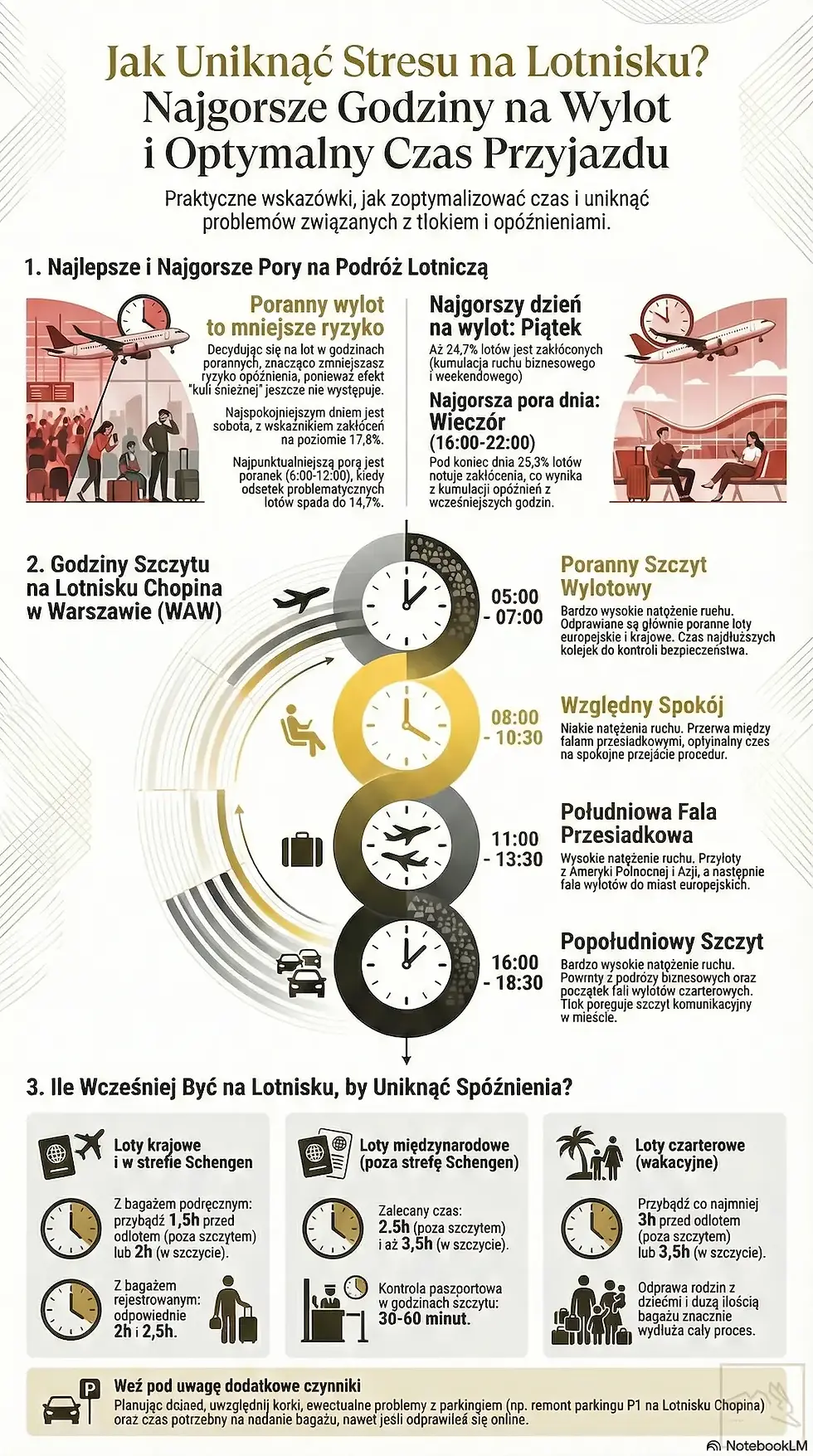
Key takeaways for passengers
Here are the most important rules that will help you get through the airport smoothly:
The 6:00 AM Rule: Regardless of the airport, the hours between 5:30 and 7:00 AM are always the busiest. Airlines strive for maximum daily turnover, hence the morning peak. Arrive at the airport with plenty of time to spare.
Transfers in Warsaw: During rush hours (12:30–14:00 and 16:00–17:00), avoid transfers of less than 60 minutes. These are critical times for baggage handling.
Night flights: Katowice and Modlin operate heavily at night. If you're picking someone up at 2:00 a.m., expect traffic similar to daytime traffic.
Evening Returns: At regional airports, late arrivals (10:00–11:00 PM) often mean there are no taxis available at the taxi rank. Book your transfer in advance.
FAQ: Rush Hours and Air Travel Planning in Poland
The section below contains answers to frequently asked questions about avoiding crowds and moving efficiently around Polish airports in the 2025/2026 season.
When are Polish airports busiest? Terminals are busiest nationwide every day in the early morning, between 5:30 and 7:30 a.m., during the first wave of departures.
How early should you be at the airport during peak hours? For morning flights departing before 8:00 AM, it is recommended to arrive at the airport at least 2.5 to 3 hours before your scheduled departure time.
When should you avoid departing from Warsaw Chopin Airport? The most critical times are the morning business wave (6:00–7:45 AM) and the afternoon peak for Asian and European departures (3:00–5:00 PM).
Why are the lines at security the longest in the morning? Airlines (especially low-cost ones) schedule takeoffs for their base aircraft almost simultaneously at dawn to maximize the number of flights per day.
Is Katowice Airport crowded at night? Yes, Pyrzowice is a major charter hub operating 24/7, with peak holiday departures often occurring between 1:00 AM and 4:00 AM.
When is Krakow Airport busiest? Extreme traffic occurs from 5:45 to 7:15 a.m. (departures) and at night after 10:30 p.m. (returns), due to the high number of low-cost airline connections.
How long does it take to transfer at Okęcie during peak hours? During peak arrival times (around 1:00 PM and 4:30 PM), it's recommended to have at least 60–90 minutes for the transfer, especially when crossing the Schengen zone.
When is the hardest time to get to Gdańsk Airport? The airport's peak traffic period overlaps with the city's afternoon rush (4:00–5:30 PM), making access difficult, and the terminal is crowded with flights returning from Scandinavia.
Does Fast Track help you avoid morning traffic jams? Yes, but at the largest airports (Warsaw, Krakow), queues of several minutes can form between 6:00 and 7:00 a.m., even to use Fast Track.
When are the busiest times for arrivals at Modlin? The peak in arrivals occurs late in the evening (10:30 PM–12:30 AM), which often makes it difficult to quickly get from the airport by public transport.
Does the time of day affect baggage waiting times? Yes, during peak arrival times (e.g., the "midday wave" in Warsaw around 1:00 PM), waiting times for baggage can be significantly longer due to busy sorting areas.
When are the busiest charter flights? Charter flights typically depart at night or very early in the morning (Katowice, Poznań), ensuring tourists arrive at their hotels in time for their check-in.
When is the "quiet window" at airports? Relatively less traffic is typically in the middle of the day, between 12:00 and 14:00 (except at connecting hubs), and late in the evening for departures.
What's the difference between weekday and weekend peak traffic? During the week, morning and afternoon peaks (business traffic) dominate, while on weekends, traffic is more evenly distributed throughout the day.
How do I check if my flight will arrive at peak time? If your flight departs between 6:00 and 7:30 AM or between 4:00 and 6:00 PM, you'll almost certainly encounter peak passenger traffic.



Comments