
Taxi in Australia: Down Under from the Backseat, Everything You Need to Know

Wondering how taxis work in Australia and why they look so different from city to city?
The Australian taxi system is a mix of tradition, technology and local regulations that may surprise any tourist.
From the luxurious Silver Service in Sydney to the yellow Camry in Melbourne, the choice of services, tariffs and apps is huge.
If you want to know how not to overpay, when it's worth choosing a taxi over Uber, and which companies dominate the market, this guide is for you.
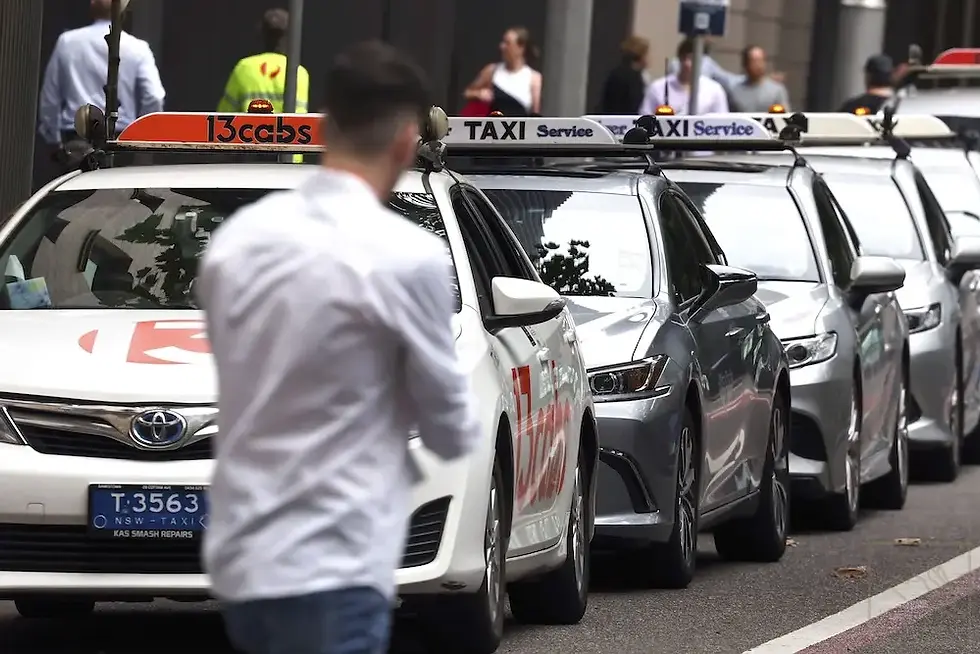
What do Australian taxis look like?
The appearance of the vehicle you enter depends largely on the state you're currently in. Local regulations can vary dramatically, affecting the aesthetics of the streets.
Victoria (Melbourne) is the most visually organized. Here, every "rank and hail" taxi—that is, one hailed from the street—must be uniformly painted "Victorian Taxi Yellow." This legal requirement allows for immediate distinction between a licensed vehicle and an Uber or DiDi.
In New South Wales (Sydney) and Queensland (Brisbane), however, there is no requirement for a single colour.
Vehicles adopt the colors of their network – most often you'll see white cars with orange accents (13cabs) or silver limousines (Silver Service). The only constant elements are the roof lamp and side numbers.
In Western Australia (Perth) , white predominates with large Swan Taxis branding, often decorated with local motifs.
What does the tariff system and price lists look like?
Australia uses a clever dual system that is worth understanding before your first course.
If you're hailing a taxi from the street or a rank ( Rank and Hail ), prices are strictly regulated by the state government (maximum prices) and the taximeter must be turned on . This changes when booking ( Booked Services ).
Here, pricing is deregulated, and apps can offer a "Fixed Price"—a fixed rate that won't increase even in extreme traffic jams. This is a direct response to Uber's model.
Importantly, maximum fare increases were introduced in 2025 (e.g., by 2.8% in Victoria), reflecting rising labor costs. Also, remember that paying by card in a taxi is typically subject to a 5% surcharge (this was reduced from 10% following regulatory intervention).
What are the most common taxi vehicles?
The Australian fleet is one of the most modern in the world, mainly due to strict vehicle age limits (usually 6-8 years old).
The absolute king of the road is the Toyota Camry Hybrid , accounting for over 40% of the fleet due to its reliability and low fuel consumption.
For groups, the standard is a Toyota HiAce (Commuter) , operating as a Maxi Taxi.
Traditional sedans such as the Ford Falcon or Holden Commodore are slowly becoming a thing of the past, replaced by more comfortable SUVs (Toyota RAV4, Kluger) that make getting in and out easier.
Top taxi companies in Australia
The market is highly polarized. We have one undisputed giant, and beneath it operates a mosaic of smaller players and regional cooperatives. These are the key players in this scene.
13cabs – the largest taxi network in the country
This isn't just any transportation company, but a powerful technology and marketing network (Network Service Provider). It operates in most states and has over 8,500 vehicles.
In 2024, a big change took place – the chain was fully taken over by the Singaporean giant ComfortDelGro .
Interestingly, 13cabs positions itself as "Australia's Cab Company", playing on national sentiment in opposition to the American Uber.
GM Cabs - Services in Sydney and Melbourne
13cabs' main rival in metropolitan areas, GM Cabs, stands out with its innovative hybrid model, introducing a "Taxi-Share" service that combines the benefits of a taxi with the flexibility of ridesharing.
They are also a technological powerhouse when it comes to payment terminals – many independent drivers choose their devices instead of the competing Cabcharge.
Silver Service – premium luxury rides
This brand (part of the ComfortDelGro stable) is a proposition for the more discerning. It guarantees newer vehicles (often Lexuses or Mercedes) and drivers in uniform.
Although in some states a prestige fee (so-called "Silver" service, e.g., $11) is added to the bill, the passenger receives a guarantee of quality in return, which is appreciated by corporate customers.
Rydo – an application that collaborates with local businesses
Rydo is a kind of "Uber for taxis." The app aggregates over 15,000 drivers from various networks.
Its huge advantage is the ability to order legal taxis that can use bus lanes, but at fixed prices known in advance (Fixed Price). It is an official partner of the NSW Taxi Council.
ACT Cabs and Orange Taxis – regional local services
Local markets have their own heroes:
ACT Cabs (Canberra): A leader in the nation's capital, known for its solid handling of government contracts, although their app has been criticised for flaws compared to national giants.
Orange Taxis (NSW): A phenomenal example of a local cooperative operating since 1955. They started with 6 cars and today have 30 modern vehicles and their own app, effectively defending the Orange region wine market from Uber's expansion.
Companies offering airport and intercity transfers
The long-distance transport niche has been filled by companies such as Evoke and Blue Diamond Transfers .
They offer luxury travel between cities (e.g. Sydney-Canberra), competing with domestic flights with door-to-door convenience and no need for cumbersome airport check-in.
What are taxi prices in Australia?
Below you'll find a list of approximate maximum rates for street-hailing services (Rank & Hail). Please note that when booking through the app, prices may be lower and fixed.
The conversion rate used for the estimates is: 1 AUD ≈ 0.60 EUR.
City / Region | Flagfall - Day | Rate per km (Day) | Initial Fee - Night/Weekend | Rate per km (Night/Weekend) | Home Company and Contact |
Sydney (NSW) | $5.00 AUD (~3.00 EUR) | $2.52 AUD (~1.51 EUR) | $6.00 AUD (~3.60 EUR) | $3.00 AUD (~1.80 EUR) | 13cabs Tel: 13 2227 App: 13cabs |
Melbourne (VIC) | $5.25 AUD (~3.15 EUR) | $2.04 AUD (~1.22 EUR) | $6.55 AUD (~3.93 EUR) | $2.27 AUD (~1.36 EUR) | Silver Service Tel: 133 100 App: Silver Service |
Brisbane (QLD) | $3.70 AUD (~2.22 EUR) | $2.69 AUD (~1.61 EUR) | $6.00 AUD (~3.60 EUR) | $2.69 AUD (~1.61 EUR) | |
Canberra (ACT) | $5.60 AUD (~3.36 EUR) | $2.55 AUD (~1.53 EUR) | $6.20 AUD (~3.72 EUR) | $3.36 AUD (~2.01 EUR) | |
Orange (Regional) | $5.11 AUD (~3.07 EUR) | $2.41 AUD (~1.45 EUR) | ~$6.00 AUD (~3.60 EUR) | $2.87 AUD (~1.72 EUR) | Orange Taxis Tel: 131 008 App: Orange Taxis |
Types of taxis available in Australia
The Australian fleet is diverse and tailored to the specific needs of passengers – from quick city travel to transporting large groups.
Standard Taxi – the basic means of transport
Most often, it's a hybrid sedan or station wagon (Toyota Camry), seating four passengers. It's the "workhorse" of Australian cities, encountered on every corner.
Maxi Taxi – perfect for groups and large luggage
If you are traveling in a larger group (up to 10-11 people), look for Toyota HiAce minibuses.
Important fare note: if 5 or more people are boarding , the driver has the right to charge a higher fare, which is often +50% to the basic price .
Wheelchair Accessible Taxi (WAT) – vehicles for people with disabilities
Australia prioritizes these vehicles. These are Maxi Taxis equipped with lifts. Interestingly, the government subsidizes drivers with a so-called "lifting fee."
This is to encourage them to serve people with disabilities rather than competing for profitable airport contracts.
Luxury Taxi – comfortable rides for premium customers
This sector is primarily served by Silver Service brands and dedicated limousines (with VHA/VHB plates). Here, you'll encounter premium European brands and a higher standard of service.
London Taxi in Australia - Stylish and affordable vehicles
An interesting fact from down under: in Perth, Adelaide and Melbourne you can find LEVC TX models – modern, electric taxis in the London style .
They are valued for their incredible maneuverability and spaciousness, although they constitute a rather expensive niche.
Hybrid Taxi Fleet – ecological transport solutions
The pressure to be eco-friendly is enormous. In the 13cabs network, over 75% of the fleet in major cities is hybrid, and the entire industry is striving for full electrification by 2030.

Specialist taxi services in Australia
Taxis in Australia do more than just transport people from point A to point B. The range of additional services is surprisingly wide and meets the specific needs of residents.
Airport Transfer – convenient transfers to and from the airport
At Sydney and Melbourne airports, there are official taxi ranks with staff (Taxi Marshals) who direct passengers to their cars.
Taxis have a huge advantage over Uber here – the ranks are located right at the exit of the terminal, which saves you having to walk around with your luggage.
Parcel Delivery by Taxi – delivery of parcels and documents
This service exploded during the pandemic and is here to stay. The taxi operates like a 24/7 express courier.
Best of all, you can track your package on the map in real time, just as you track your driver's arrival.
Taxi for Pets – pet transport
13cabs offers a dedicated pet transport service. The driver arrives with a protective mat and is "pet-friendly." This is a direct response to the competing service Uber Pet .
Taxi Baby Seat – child seats on request
The regulations here are complicated and worth knowing. In NSW, children under 12 months must absolutely travel in a car seat – you can book a taxi with this equipment (e.g., from Silver Service), but you must do so in advance.
In Victoria and Queensland, taxis are often exempt from having to carry child seats for older children, although for safety reasons it is always recommended to have your own.
NDIS Transport and Taxi Subsidy Scheme – support for people with disabilities
The co-payment system is extensive. Programs such as MPTP (Victoria) and TTSS (NSW) allow eligible passengers to cover 50% of the fare (up to a limit of $60). This is done cashlessly and automatically via the Cabcharge terminal.
Booking and using taxi services
Using taxis in Australia is intuitive, but it's worth knowing a few tricks that will make your life easier and save you time.
How to book a taxi in Australia?
In addition to modern applications, the classic "hail" is still very popular. The principle is simple: if the "TAXI" light on the roof is on, the car is clear.
However, remember that in the city center (CBD) areas there are often designated taxi ranks (Taxi Ranks) which should be used for safety and traffic flow reasons.
When to choose a taxi over other forms of transport?
A key advantage taxis have over Uber is access to bus lanes (Transit Lanes T2/T3) . During peak hours in Sydney, taxis can legally bypass traffic jams using bus lanes, something Uber (usually) can't. This often makes taxis faster during peak hours.
24/7 services and availability across regions
Taxis are legally obligated to provide services 24 hours a day. This is especially crucial in rural areas and smaller towns, where ridesharing availability can be nonexistent or very limited at night.
Australian Taxis Apps and Technologies
The technology in Australian taxis is at a very high level, often surpassing solutions known from Europe.
Taxi App Australia - Most popular booking apps
The market leaders are 13cabs , Rydo , and GM Cabs . They are fast, intuitive, and offer a full route overview.
MyDriver Feature – Choose your favorite driver
This unique feature in the 13cabs and Rydo apps builds trust. Passengers can save a "favorite" driver. The system will offer that driver the first ride the next time they request a ride. This is a great solution for those who value trusted company.
Fixed Fare Taxi – a pre-determined fare for the ride
Most apps offer a " fixed price " option. The price you see when ordering is the final price. This eliminates the passenger's age-old fear of "spinning odometer" in traffic.
Taxi Safety Features – safety and monitoring standards
In NSW and Victoria, cameras inside taxis are mandatory . They record audio and video, and only police or the regulator have access to them in the event of an incident. This solution has dramatically improved safety for both drivers and passengers.
Cabcharge – the dominant cashless payment system
This system (owned by ComfortDelGro/A2B) is the standard for 98% of taxis. It offers not only card payments but also special cards for companies, vouchers, and e-tickets, making it extremely convenient for business payments.
Regulations and organization of the taxi market
The market is strictly regulated by individual states, which creates some differences in regulations that are worth knowing about.
Taxi Regulation Australia – differences between states and territories
Each state has its own regulator (e.g., the Point to Point Transport Commissioner in NSW). Regulations vary, including maximum rates and vehicle paint requirements, as mentioned at the beginning.
Taxi License Australia - Driver Licensing Requirements
Becoming a taxi driver requires a specific path. Drivers must hold a Driver Authorization (DA), undergo rigorous medical tests, and undergo a police record check.
Taxi Services Commission - oversight in Victoria
Currently, this role is performed by Safe Transport Victoria. This body is renowned for its rigorous enforcement of standards and was responsible for introducing the uniform yellow taxi color that has become a hallmark of Melbourne.
Taxi Industry Inquiry (Victoria) – sector reform 2011
The so-called Fels Report is worth mentioning. It was a turning point that deregulated the market, lowered licensing costs (which had previously cost an astronomical $500,000!), and opened the door to real competition.
A2B Australia's Role in the Taxi Industry
It is impossible to talk about Australian taxis without mentioning the company that has been ruling this market for years.
The operator of the 13cabs network and the owner of the Cabcharge system
By 2024, A2B was the largest player, holding all the cards: technology (MTI), payments (Cabcharge) and the transportation network (13cabs).
A2B Australia's Impact on Service Standards and Innovation
In April 2024, ComfortDelGro completed the acquisition of A2B . This historic consolidation aims to create a single, powerful front against global ride-sharing platforms, combining taxis, buses, and medical transportation under one roof.
FAQ: Frequently asked questions about taxis in Australia
I have collected answers for you to the most frequently asked questions that may arise when planning a trip, covering issues of costs, safety and local regulations.
Are taxis in Australia safe? Yes, Australian taxis are very safe. In most states, surveillance cameras inside the vehicle are mandatory, and the vehicles have GPS tracking systems.
Is Uber cheaper than a traditional taxi? Usually, but not always. During peak hours, when Uber operates surge pricing, a fixed-price or metered taxi may be the cheaper option.
Can you pay by card in an Australian taxi? Yes, every taxi has a payment terminal. However, please note that a service fee (surcharge) of around 5% is usually added to the transaction.
Can taxis use bus lanes? Yes, that's a huge advantage. Legal taxis can use bus lanes (Transit Lanes), which significantly reduces travel times during peak hours.
Do I need to have my own child seat in a taxi? It depends on the state. In Victoria and Queensland, taxis are often exempt from this requirement for older children. In NSW, children under 12 months of age must absolutely travel in a child seat.
What is a Maxi Taxi and how much does it cost? It's a minibus (van) taxi for groups of 5-11 people. If you're traveling in a group of 5 or more, a 50% surcharge is typically added to the standard meter fare.
Is tipping taxi drivers in Australia acceptable? Tipping is optional. However, it's considered polite to round the amount to the nearest dollar or leave a small amount as a thank you for good service.
How to recognize a legal taxi? A legal taxi must have a roof light (illuminated when unoccupied) and side numbers. In Victoria, the mandatory color for the bodywork is yellow.
Can I bring my dog in a taxi? Yes, but it's best to book the "Taxi for Pets" service or get permission from the driver. Assistance dogs must be accepted at all times and at no extra charge.
What does "Flagfall" mean in the pricing? This is the initial fee for simply getting into the taxi ("slamming the door"), charged at the start of the ride. It typically ranges from AUD 3.50 to AUD 7.80, depending on the time of day.
Is the price for a ride from the airport fixed? Not always. Typically, there's a taximeter plus an airport access fee. You can only get a fixed price by booking a ride online with the "Fixed Price" option.
How is Silver Service different from a regular taxi? Silver Service is a premium service. You get a newer, luxury car and a uniformed driver, for which there's usually an additional fee (around $11).
Are there wheelchair accessible taxis (WATs) in Australia? Yes, the Wheelchair Accessible Taxi fleet is widely available and government-subsidized, ensuring priority service for wheelchair users.
How does the Taxi Subsidy Scheme work? Eligible individuals have a special smartcard. When paying through the terminal, the card automatically covers 50% of the fare (up to a set limit).
Can I hail a taxi on the street with a wave of my hand? Yes, if the roof light is on, you can legally hail a taxi in a safe place, except in strict no-hailing zones.
What should I do if I leave something in a taxi? Contact the taxi service (e.g., 13cabs) with the taxi number or the time and route of the trip. That's why it's always worth taking the receipt—it has all the necessary information.


Comments