
How early should you be at the airport? Passenger Guide

It's best to arrive at the airport about two hours before departure, or even two and a half to three hours in the case of major airports, connecting flights, or flights in the non-Schengen area. This will allow you to easily navigate check-in, security, and arrive at your gate without stress.
One thing's for sure: showing up just an hour before takeoff, even at a small airport, is asking for trouble. This guide will give you specific tips on how to match your arrival time to your flight type, airline, and airport, so your trip starts stress-free and at your desired pace.

Standard recommendations "2 hours before departure"
The standard rule is to arrive at the airport approximately two hours before your scheduled departure . This recommendation allows for a smooth check-in and pre-flight security check.
For intercontinental flights and large international airports, up to 3 hours of extra time is often recommended.
This allows us to gain a margin of time for any queues and additional procedures related to, for example, passport control or verification of travel documents.
How far in advance do you have to be at the airport in practice?
Flight type (domestic vs. international): Domestic flights typically require less time. It's often sufficient to arrive 1-1.5 hours before departure for a domestic flight, especially from a small airport. However, for international flights (especially out of Europe), it's standard to arrive at least 2-3 hours in advance to accommodate passport, visa, and baggage checks.
Airport size and traffic: Large, busy airports (e.g., Warsaw Chopin) handle more passengers, which means longer lines for security and check-in. A longer wait is recommended – around 2 hours for European flights and 3 hours for intercontinental flights . Smaller regional airports tend to be less crowded, so processing times may be shorter, but it's still better to arrive early, especially during peak hours.
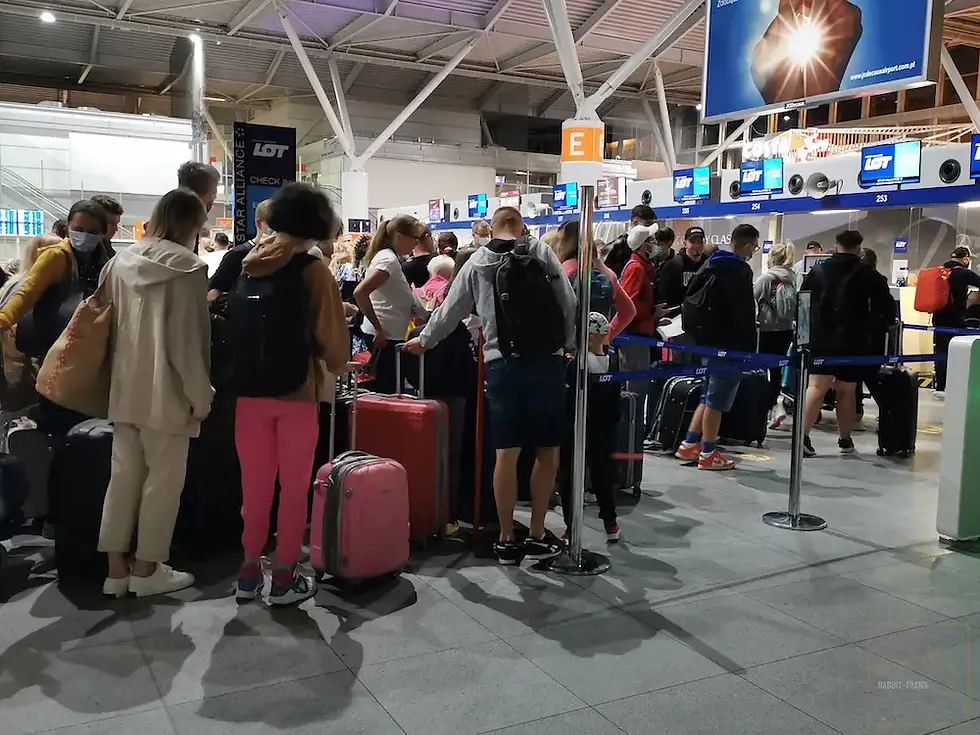
Time of day and year: During peak hours, such as 5 a.m.–7 a.m. and 4 p.m.–6 p.m., airports are busiest and lines are longest. Similarly, airports are busier during the summer holiday season than in winter. During holiday and vacation periods, allow extra time because more people are traveling at once.
Luggage and check-in: If you're traveling with only carry-on baggage and have a boarding pass from online check-in , you can proceed directly to security, bypassing the check-in desks. Experienced travelers often find that even about an hour before departure is sufficient . However, if you have checked baggage to drop off , check-in takes extra time. It's a good idea to arrive at least three hours before your international flight to check in your suitcase and go through security without rushing.
Getting to the airport: Plan your transportation in advance. Check traffic forecasts and travel times, especially if the airport is far from the city center. For example, Modlin (an airport near Warsaw) takes 40–60 minutes by car or about 1 hour by train. Factor in possible public transportation delays or parking issues. For convenience, many travelers choose a taxi or airport shuttle in advance , which allows them to arrive at the terminal on time. Remember that large airports can have crowded parking lots and driveways – it's better to have extra space than to be stuck in traffic at the airport.
Special circumstances: If you're traveling with children, people with limited mobility, or require special assistance , plan for extra time. Airlines recommend that passengers requiring additional assistance arrive early—for example, wheelchair users should arrive at the airport one hour before standard check-in time (up to 4 hours before an international flight ). Similarly, if traveling in a large group, allow time for gathering and organizing everyone at check-in.
What are the recommendations from individual airlines?
Each airline may have its own guidelines regarding how early passengers should arrive at the airport . Differences are primarily due to the carrier's check-in procedures and the type of flight.
Below you will find recommendations from popular airlines on the Polish market , grouped by required time of presence before departure:
Ryanair – This Irish low-cost carrier recommends arriving at the check-in desk at least two hours before departure . This is especially true for passengers who need to verify a reservation (e.g., purchased through a travel agent) or check in baggage. Ryanair requires arrival at the gate no later than 30 minutes before the flight's scheduled departure time – boarding may be closed after this time.
Wizz Air – The Hungarian low-cost airline also recommends arriving early. Wizz Air check-in and baggage drop desks open 2 hours before departure and close 40 minutes before departure . This means you must check in your luggage and collect your boarding pass no later than 40 minutes before takeoff – after that, check-in is closed. The carrier notes that check-in may open earlier or close slightly earlier at some airports, so it's always worth giving yourself some extra time.
LOT Polish Airlines – The national carrier, LOT Polish Airlines, recommends arriving 2 hours before departure for domestic and short-haul flights (Europe, the Middle East, North Africa) and 3 hours before long-haul (intercontinental) flights . Check-in for LOT flights opens this early. It's worth remembering that LOT has strict check-in closing times – for example, for domestic flights, check-in closes 30 minutes before departure , for European flights 40-50 minutes before departure (depending on the Schengen area), and for flights to the US or Asia 70 minutes before departure . After these deadlines, passengers without checked baggage and a boarding pass will not be allowed to board.
Other traditional carriers: Most scheduled airlines (e.g., Lufthansa, Air France, KLM, British Airways) have similar rules to LOT. Check-in typically opens 2 hours before departure (for European flights) and about 3 hours before intercontinental flights , especially from major hubs. Check-in usually closes 40-60 minutes before departure, depending on the airline and airport's requirements. It's always worth checking your ticket or airline's website for check-in closing times —they can vary; for example, American Airlines requires check-in no later than 45 minutes before domestic flights and 90 minutes before international flights, while Asian and Middle Eastern airlines often ask for earlier arrival due to additional security procedures.
Polish airports – how early is it best to arrive?
The recommended arrival time may vary slightly depending on the airport. Most Polish airports recommend arriving about two hours before departure , but it's worth knowing the specifics of the largest ones:
Warsaw Chopin Airport (WAW): Poland's largest airport. Check-in opens 2 hours before departure for European flights and 3 hours for long-haul flights. This means that if you're traveling from Okęcie Airport to another European city, for example, 2 hours of extra time should be sufficient, but if you're flying from there to the US or Asia, it's best to arrive 3 hours in advance .
Warsaw-Modlin (WMI): An airport near Warsaw serving mainly low-cost airlines (Ryanair). Modlin Airport recommends arriving 2 hours before a domestic flight and 3 hours before an international flight . Interestingly, Modlin Airport recommends that passengers traveling with small children or large checked baggage arrive even earlier – up to 3 hours (domestic flight) or 4 hours (international flight) before departure . This is due to the longer processing time for such passengers.
Kraków-Balice (KRK): According to official information, all passengers should arrive at the airport at least 2 hours before their scheduled flight departure time . Check-in at Kraków typically opens 2 hours before departure and closes 40 minutes before departure , although the exact closing time may vary depending on the airline.
Gdańsk Lech Wałęsa Airport (GDN) : The official recommendation is to arrive at the airport at least two hours before your scheduled departure . The Gdańsk airport emphasizes that check-in always begins according to the airline's schedule – so it's worth checking with your carrier, but a two-hour window is safe.
Katowice-Pyrzowice (KTW): This airport has slightly different check-in times for different flight types. You should check in 120 minutes before international departures and 60 minutes before domestic departures . So, if you're flying from Katowice to another city in Poland, about an hour is enough , but for a flight to another country, you'll need to check in 2 hours beforehand .
Poznań-Ławica (POZ): according to the Poznań airport website, it is recommended to arrive at least 2 hours in advance , as check-in and security checks can take a long time.
Other regional airports: Airports in Wrocław, Rzeszów, Szczecin, Lublin , and other cities also typically suggest about 2 hours before departure for most flights. For a few domestic connections (e.g., formerly from Warsaw to Wrocław or Gdańsk), 1–1.5 hours might be sufficient, but currently, even for domestic flights, carriers and airports in Poland generally adhere to the 2-hour standard for traveler safety.
Note: The times above are recommendations and assume typical conditions. During busy periods (e.g., before holidays, long weekends) or during times of increased security, it's worth arriving even earlier . I would recommend adding an extra hour to these times. It's always better to wait a bit at the airport than to miss your flight.
What does it look like at airports around the world?
Polish standards align with global recommendations. Many countries adopt a similar rule: approximately two hours before departure for domestic flights and three hours before departure for international flights .
For example, in the United States, the TSA (transportation security agency) recommends arriving at security 2 hours before a domestic flight from a major airport and 3 hours before an international flight , especially during holiday or vacation periods.
Of course, it also depends on the airport and country. At smaller regional airports around the world, 1–1.5 hours is often sufficient (e.g., internal flights in small countries). However, the world's largest and busiest airports often suggest even more. Examples:
At London Heathrow Airport , airlines usually recommend 3 hours before departure for intercontinental flights, due to the large number of passengers and long lines at security.
In Israel (Tel Aviv), it is standard to arrive up to 3 hours before departure for international flights, which is associated with very thorough security checks carried out at local airports.
In some African and South American countries, requirements are even higher during peak season. The Federal Airports Authority in Nigeria , for example, recommends about three hours before an international flight and up to four hours during peak periods . Similarly, in Chile, travelers are asked to arrive at Santiago Airport about three to three and a half hours in advance for overseas flights.
As you can see, 2-3 hours before departure is the global standard, and in some places even longer . If you're traveling internationally, always check the recommendations for your specific airport and airline.
Sometimes carriers send emails reminding you to arrive earlier (e.g., due to additional document checks during the COVID-19 pandemic or vaccination verification – this was the case in 2021, when Wizz Air encouraged you to arrive two hours earlier to check your certificates). It's better to take such messages seriously.
What if you are going to be late on your way to the airport?
Life is unpredictable, and sometimes, despite our plans, we arrive at the airport later than the regulations recommend . What then? If we arrive after the recommended time, is all lost?
Not necessarily – a lot depends on how late we are and whether we make it before check-in and the gate officially close. Here are some tips:
Know your check-in and boarding cutoff times: Each airline specifies the deadline for check-in and baggage drop-off, as well as the latest time you must arrive at the gate. Check-in typically closes 40-45 minutes before departure – after this time, you can no longer check in checked baggage. For example, Wizz Air closes check-in 40 minutes before takeoff, while LOT closes check-in for European flights 45-50 minutes before takeoff (up to 30 minutes for domestic flights). The boarding gate typically closes around 15-30 minutes before departure , depending on the airline – for Ryanair, it's exactly 30 minutes before departure. If you arrive at the airport after check -in or the gate closes, unfortunately, you won't be allowed to board – the plane won't wait, and your ticket will be forfeited (unless you have a flexible fare that allows you to change your flight).
Minimum time for latecomers: If you already have a boarding pass (you checked in online) and only carry-on luggage , you can theoretically arrive relatively late – sometimes 45–60 minutes before departure is enough . However, you should also consider that security checks take time. In practice, even with small luggage, try to arrive at least an hour before departure – for example, Chopin Airport suggests that with just a carry-on suitcase, the absolute minimum is about 60 minutes before departure , as security gates close about 30 minutes before departure . This half-hour is necessary to get through security and to the gate before the boarding staff ends.
Prioritizing late passengers: If your flight is very close to departure and you've just arrived at the airport, try contacting the staff . Sometimes (though not guaranteed), airport staff will help you through security faster if there's a chance you'll make your flight—especially if the next flight of the day isn't for hours. This is especially true if the flight hasn't departed yet and the gate hasn't closed . For example, it's not uncommon for a late passenger without checked baggage to be rushed through security and taken straight to the gate just before departure. However, this is staff's good faith and shouldn't be relied upon —officially, airlines require you to arrive early and have the right to refuse boarding if you're late.
If your flight leaves without you: If you actually miss your flight and your flight departs, unfortunately, your ticket is usually forfeited (certainly with low-cost airlines, but with regular airlines, it depends on the fare—non-refundable tickets are often forfeited as well). You'll then need to purchase a new ticket for your next flight. It's worth contacting the airline's customer service desk immediately—sometimes they'll offer to rebook your ticket for a fee on the next flight. If the delay was caused by unrelated circumstances (e.g., traffic jam due to an accident, a canceled train to the airport) and you have proof, you can try to claim reimbursement from your travel insurance—provided you have it and your policy covers such events. However, this is a difficult path, so it's better to prevent a delay than to suffer its consequences later.
Top tips for latecomers
Most airports and airlines recommend:
Domestic flights (within Poland): arrive approximately 1.5–2 hours before departure.
International flights (Europe): approximately 2 hours before departure.
Intercontinental flights: at least 3 hours before departure time.
Check your carrier's requirements: Read the information on your ticket or airline's website. For example, Ryanair and Wizz Air expect a 2-hour wait (check-in ~40 minutes before the flight), while LOT opens check-in 2-3 hours before and closes 30-70 minutes before departure.
Consider the specifics of the airport: Large, busy airports (Warsaw, Krakow) = more time to spare. Smaller airports = shorter queues, but a minimum of two hours is still a safe rule. If the airport is located far from the city (e.g., Modlin), plan your journey with extra time.
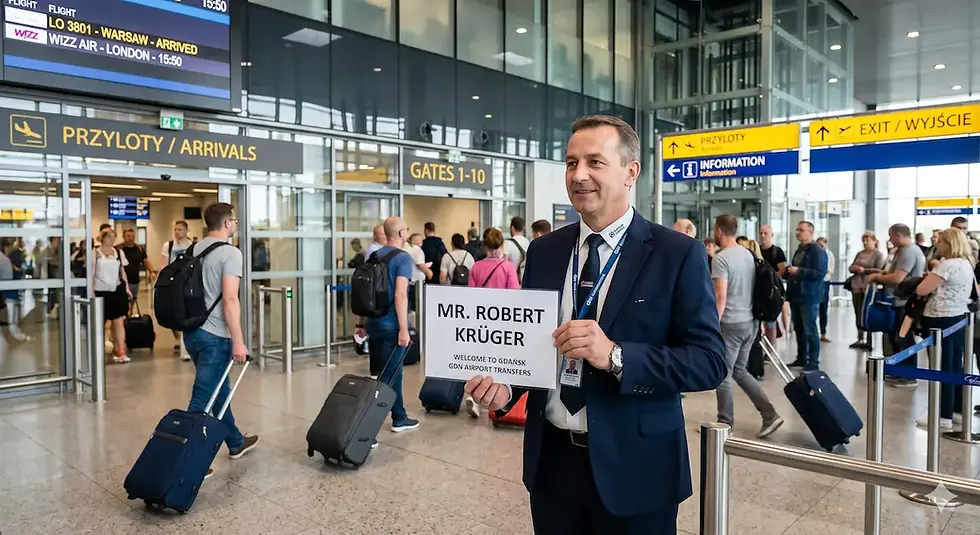
Book your airport transfer in advance : To ensure you arrive on time, it's worth booking a taxi or specialized airport transfer the day before. Relying on apps like Uber, Bolt, and cheap taxi companies that book "on the spot" can often be unreliable, especially during peak hours or when driver availability is limited. Reliable and planned transportation is key to a smooth journey.
Travel stress-free: It's better to arrive early than late. If you complete all procedures quickly , you'll have time for coffee, a meal, or duty-free shopping. Arriving early allows you to handle everything calmly, without the stress of rushing around the terminal.
Check in online and limit your baggage : These tips will help you save time. Having your boarding pass on your phone and only carrying carry-on luggage will help you skip the check-in lines and arrive a little later (though we still recommend having a reasonable amount of luggage).
Remember: time at the airport is never wasted . A moment of waiting is far better than missing your flight.
By following the above recommendations, you'll begin your journey calmly and without unnecessary rushing – and that's what successful vacations and business trips are all about. Have a safe journey and a pleasant flight! ✈️



Comments