
Working as a taxi driver in Germany: What are the requirements and how to get a license Personenbeförderungsschein

The year 2026 brought revolutionary stability for anyone thinking about earning money behind the wheel in Germany.
After years of legislative chaos and the reform of the Passenger Transport Act ( PBefG ), the current legal situation is exceptionally favorable – especially for new drivers and economic immigrants from Poland.
This guide is your roadmap: I will guide you through the current regulations, eliminating official jargon and showing you the shortest route to the profession.

Formal requirements for working as a taxi driver in Germany
German road traffic law makes it clear: knowing how to drive is one thing, but being responsible for your passenger is another. Before even considering an app, you need to understand the fundamental difference between a regular driver's license and a commercial license.
The legal basis here is § 48 of the Road Traffic Licensing Regulation (Fahrerlaubnis-Verordnung – FeV) , which specifies that each commercial transport requires an additional certificate.
Personenbeförderungsschein – mandatory license for passenger transport
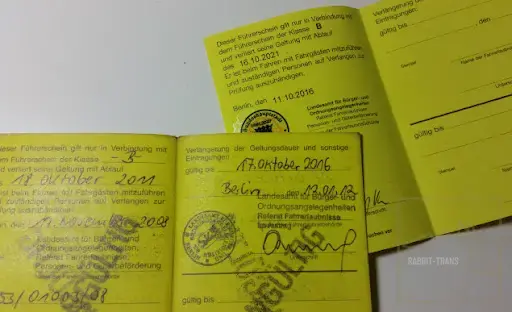
The document without which you cannot leave your place is the Führerschein zur Fahrgastbeförderung (FzF), known in the industry simply as P-Schein .
This is an official document – usually in the form of a yellow or pink insert (less often a card) – which gains legal force only when paired with your ID card and a valid driving license.
Who exactly does this apply to? The regulation is broad: it covers drivers of taxis, rental cars ( Mietwagen – platforms like Uber, Bolt, FreeNow ), transport ambulances ( Krankenkraftwagen ), and tour buses with up to 8 passengers.
Legal basis – § 48 section 1 FeV: "Einer zusätzlichen Erlaubnis (Fahrerlaubnis zur Fahrgastbeförderung) bedarf, wer einen Krankenkraftwagen führt [...] oder wer ein Kraftfahrzeug führt, wenn in dem Fahrzeug Fahrgäste befördert werden und für diese Beförderung eine Genehmigung nach dem Personenbeförderungsgesetz erforderlich ist.
(Translation: An additional permit is required by anyone who drives an ambulance [...] or by anyone who drives a motor vehicle in which passengers are transported, and for this transport a permit is required in accordance with the Passenger Transport Act).
The only exception to this rule are bus drivers (with category D or D1) – their professional qualifications already include this privilege.
Terrain Knowledge Test – What does it include and how to prepare?
I have great news for you – the famous "topography" exam is a thing of the past. Historically, the street knowledge exam ( Ortskundeprüfung ) was the most difficult entry barrier, with many candidates failing.
Although it was abolished in 2021, the specter of its replacement by the so-called "Small Skills" ( Kleine Fachkunde ) hung over the industry for years.
The situation is clear in 2026. In October 2025, during the conference of the federal states, the final decision was made: the complete abolition of the "Minimal Skills" theoretical exam .
This decision, supported by 14 of the 16 federal states, means in practice:
No state exams: You no longer need to pass tests on local knowledge or regulations to drive a Taxi or Uber.
Change of responsibility: The burden of navigation now rests with GPS systems, and fleets only conduct short, in-house training courses on application use and quality standards.
Certificate of no criminal record – how and where to obtain it?
The verification of your background is rigorous (unlike in Poland), because the official must confirm your "special responsibility" ( besondere Verantwortung ). A simple court printout won't suffice .
You must apply for the Führungszeugnis der Belegart O (version for official purposes). The key difference lies in the document flow: this certificate will never reach you.
It will be sent directly from the Federal Office of Justice ( Bundesamt für Justiz ) to the specific communications office ( Führerscheinstelle ) where you submit your papers.
For Poles living in Germany, the procedure is as follows:
You are applying for a so-called Europäisches Führungszeugnis (European Certificate of No Criminal Record).
The German office automatically sends a query to the Polish National Criminal Register.
Please note: This international exchange process takes approximately 4-5 weeks . The cost is a flat €13 .
Category B driving license – the minimum requirement for taxi drivers
The legislator leaves no room for interpretation here.
To apply for P-Schein, you must meet strict seniority and age criteria:
Driving experience: You must have held a category B driving licence (or equivalent EU/EEA licence) for at least 2 years (for ambulances, 1 year is sufficient).
Age: The minimum age for a candidate is 21 years (for ambulances the threshold is lower – 19 years).
Penalty points: This is a critical point. In practice, authorities refuse to issue licenses to those with more than 1 point on the Flensburg registry (or 5 points under the old scale). Although this is a matter of assessing "trustworthiness," officials are rarely lenient.
Health requirements and mandatory training
Since knowledge exams have been abolished, the selection process has shifted almost entirely to medical examinations. The goal is simple: eliminate drivers whose psychophysical condition could pose a risk to passengers. Be prepared to visit several specialists.
Health certificate – what tests are required?
The basis is a general medical examination, which must be carried out in accordance with the guidelines contained in Anlage 5.1 FeV (Annex 5 to the Regulation).
The doctor assesses the overall fitness of the body and excludes serious chronic diseases that could cause sudden loss of consciousness (e.g. untreated diabetes, epilepsy, serious heart defects).
Validity: The medical certificate is valid only for 1 year from the date of issue.
Cost: Typically between 80 and 120 EUR .
First aid course – who needs to complete it?
Here, the provisions of § 19 FeV make an important distinction depending on who you will be transporting:
Krankenkraftwagen (Ambulances): A first aid course is mandatory and must be documented upon application. An advanced course is often required.
Taxi and Mietwagen (Uber): According to § 19 paragraph 3 FeV, if you have already completed a first aid course (e.g. when obtaining a category B driving licence), you are theoretically exempt from the obligation to repeat it.
Reality check: If you've been getting your driver's license for a while, authorities (or fleet employers) often require you to refresh your knowledge with a 9-hour training course. It's worth it for your own peace of mind.
Eye examination and psychological exam – part of the licensing process
This is the most demanding stage, precisely regulated by Anlage 6 FeV . It consists of two independent parts:
Eye examination ( Augenärztliches Gutachten ): Must be performed by an ophthalmologist or occupational physician. The requirements are higher than for amateur drivers: visual acuity of at least 0.8 in the better eye and 0.5 in the worse eye (or 1.0 in both eyes), as well as a normal field of vision (up to 140 degrees) and twilight vision. Cost: approximately €40–50.
Psychotechnical tests ( Funktions- und Leistungstest ): Mandatory for the first application for a P-Schein (regardless of age) and for license renewal after the age of 60.
This test, commonly known as the "Vienna Test," tests reaction time, orientation, concentration, and stress tolerance. The candidate responds to auditory and visual cues (colored pedals and buttons) at a set, rapid pace.
Cost: 80 – 150 EUR .
The process of obtaining a license to transport passengers in Germany
Bureaucracy in Germany can be overwhelming, but the process of obtaining a P-Schein is currently quite linear. The key to success is following the correct sequence of steps to ensure your medical exams don't expire before your appointment with the office.
How to apply for Personenbeförderungsschein?
Preparation: Start by gathering all your medical certificates (general + vision + psychological tests). Remember, you have a year to complete this, but it's best to do it quickly.
Appointment: Go to your local traffic department ( Führerscheinstelle ) or citizen service office ( Bürgeramt ). In large cities (Berlin, Munich), booking your appointment online in advance is essential.
Application: On-site, you fill out the form, pay the fee and submit an application for a clean criminal record (paid separately).
Pick-up: Once your documents have been verified (approx. 4-6 weeks), you will receive a letter notifying you that your document is ready for pickup.
License cost and waiting time
How much do you need to invest to get started? The total cost of "document investment" in 2026 is as follows:
Official application fee: EUR 42.60 .
Certificate of no criminal record: EUR 13.00 .
Medical examinations and psychological tests: 150 – 250 EUR (depending on the doctor’s price list).
Total: Be prepared to spend around €200 – €310 .
The waiting time is on average 6 weeks , mainly due to the previously mentioned exchange of information on criminal records between Polish and German services.
Validity of the license and the obligation to renew it
The P-Schein license is not issued indefinitely. You receive it for a period of 5 years .
Extension: To maintain continuity of employment, you must resubmit an eye examination, a general medical examination, and a fresh criminal record certificate.
Age 60+: If you are over 60 years of age, you will have to repeat the psychotechnical tests (reaction time) when extending your application.
Types of work in passenger transport in Germany
The same license (P-Schein) opens the door to several different professional worlds. The path you choose depends on whether you prefer working with apps, working as a taxi driver on the road, or pursuing a medical mission. The differences are regulated directly by the PBefG ( Personal Employment Act).
Taxi, limousine and ambulance drivers – differences in requirements
Taxi: The king of the city. They can stand at taxi ranks ( Bereithalten ) and pick up passengers directly "off the street" (with a wave of the hand). However, you are bound by a fixed official tariff – you can't negotiate the price.
Mietwagen (Uber/Bolt/FreeNow): Here, the rules are dictated by § 49 paragraph 4 PBefG . The Rückkehrpflicht (return obligation) is key . After each completed ride, you must physically return to the base, unless you receive a new assignment on the way back. You are not allowed to park in the city center waiting for a customer or use taxi ranks.
Ambulance ( Krankentransport ): This is a specific job. It requires not only first aid training but also good physical fitness (lifting) and, usually, a communicative level of German to communicate effectively with medical staff in hospitals.
Work for drivers without experience – is it possible?
Absolutely. The era of having to memorize every street is over. Thanks to apps like Uber Driver and FreeNow, working without knowing the city has become standard.
For Uber drivers in Germany, the Ennoo portal is a key tool. Because Uber doesn't employ drivers directly, Ennoo helps you find a licensed fleet partner that will provide you with legal employment.
Local and long-distance transport – route characteristics
Local ("Around the Chimney"): The domain of taxis and Uber. Short routes, lots of maneuvering, start-stop systems, typical city driving.
Long-distance: More common in courier services (category B) or specialized transfers (airport, intercity medical). Rates may be higher and the journey smoother, but assignments tend to be less regular.
Employment conditions and work systems for drivers
The German labor market is undergoing a significant transformation. "Off-the-books" models are being effectively cracked down on by customs officials ( Zoll ), and full social security is becoming the norm. What can you expect in 2026?
Legal work and German employment contract – what is worth knowing?
The industry standard – both in traditional taxis and Uber fleets – is currently the German employment contract ( Arbeitsvertrag ).
This is key to stability. It provides the statutory minimum wage (approximately €12.82/hour), paid vacation time, and full insurance. Avoid companies that offer bogus self-employment ( Gewerbe ) as a starting point—it's a risky proposition.
Working without knowing German – available options
Is language an insurmountable barrier? Not necessarily.
Uber/Bolt: The language barrier is the lowest here. The app automatically translates orders, and customer interaction is minimal ("Hello," "Danke"). Many partner fleets are run by Poles or Turks, which makes communication with the boss easier.
Employment Agencies (Dungito, ASMO): They offer jobs for category B drivers (mainly couriers and delivery drivers) without any language skills . This is a great "starter" option, allowing you to earn money for your P-Schein course and acclimatize to a new country.
Residential work – when is it offered?
This is a key differentiator when choosing an employer.
Taxi/Uber: Local transportation companies rarely offer accommodations . They expect the driver to already live in the city.
Employment Agencies: Companies like ASMO Solutions and Dungito specialize in relocation. They offer jobs (primarily C+E, but also category B couriers) with accommodation provided (often free or very cheap).
Strategy: You can start as a courier with a guaranteed apartment, and after finding your own place and making a P-Schein, switch to taxi.
2/1, 3/1 and 2/2 work systems – what does the schedule look like?
Rotational systems (traveling to Poland every 2-3 weeks) are the domain of heavy transport. In the taxi/Uber industry, stationary work (daily homecoming) dominates.
However, if you want to rotate in category B, look for offers in employment agencies for delivery vans (courier) – the 3/1 or 2/1 systems are still popular there.

Where to look for job offers as a taxi driver in Germany?
Finding a job isn't a problem, but finding a good one requires strategy. You have two main options: using an agency or searching on your own.
Employment agencies in Germany – role and support for drivers
Agencies serve as a safe "bridge." They provide support from a Polish coordinator, assistance with registration, opening a bank account, and obtaining a tax number.
For a newcomer to Germany, this is a much safer option than searching on your own and risking dealing with a dishonest intermediary.
ASMO Solutions – an example agency with offers for drivers
This company is a leader in driver recruitment. Although their primary profile is heavyweight (C+E), they regularly have offers for category B drivers.
What they offer: German contract, on-time payments, support in obtaining Kindergeld and the possibility of working without speaking the language.
Contact: +48 22 123 77 20 or rekrutacja@asmo-solutions.com .
Online job offers – what to pay attention to when applying?
When looking for a job on websites such as Indeed or Kleinanzeigen , be vigilant.
Check whether the employer requires Gewerbe (activity) – for a beginner, an employment contract ( Arbeitsvertrag ) is always safer.
Use effective phrases: Taxifahrer gesucht , Mietwagenfahrer , Fahrer Klasse B.
Additional information for drivers working in Germany
Work isn't just about a salary . The German social system offers a range of benefits that truly improve your family's standard of living.
Kindergeld family benefits – who can benefit?
In 2026, the Kindergeld rate is €259 per child per month.
What is crucial – this benefit is available to every employee legally employed in Germany (subject to unlimited tax liability), even if the children live in Poland .
The application is submitted to the Family Benefits Office ( Familienkasse ).
Health insurance and other social benefits
Every driver under an employment contract is automatically insured with a state health insurance fund ( Gesetzliche Krankenkasse , e.g., AOK, TK). The contribution is split equally between the employee and the employer.
A great advantage is family insurance ( Familienversicherung ) – your unemployed wife and children can be added to your insurance completely free of charge, gaining full medical care in Germany and (thanks to the EHIC card) in Poland.
Minimum age and other formal criteria for candidates
To sum up the profile of the ideal candidate in 2026, you must meet four simple conditions:
Age: minimum 21 years .
Driving license: held for at least 2 years .
Health: no ophthalmological and psychomotor contraindications.
History: Clean police record and maximum 1 penalty point in Flensburg.
If you meet these requirements, the German passenger transport market is open to you.
FAQ: Passenger transport and driver work in Germany – questions and answers
Below you will find specific answers to the most important questions about requirements, salaries and procedures for those planning a career in German passenger transport in 2026.
Who does the P-Schein license and commercial passenger transport apply to? A P-Schein license is required for commercial passenger transport , including taxi, Uber/Bolt, and ambulance drivers ; it is necessary to legally transport people for commercial purposes.
Do professional drivers have to pass a topography knowledge test? No, in 2026, the terrain knowledge test was completely abolished, and terrain knowledge is not verified by a state exam – professional drivers can fully rely on GPS navigation systems.
What driving jobs are currently available on the market? The German market offers a variety of driving jobs , from taxi companies and private transportation companies (Uber, VIP limousines), to courier companies, guaranteeing legal employment in Germany .
Can I become a taxi driver with a category B driving license? Yes, a category B driving license is the basic requirement, but applicants must have held a driving license for at least two years, and the legal minimum age is 21 to obtain a taxi license.
What tests does a driver's health certificate include? To obtain a driver's license, you'll need an additional driver's health certificate , which includes ophthalmological and psychological examinations, as well as a general health certificate (confirming there are no contraindications to driving).
What kind of earnings can a driver expect in Germany? The standard German minimum wage plus tips makes for attractive pay for drivers , especially for full-time or shift work.
What are the most popular work arrangements for drivers? In the taxi industry, on-site work dominates, while employment agencies offer flexible work arrangements for drivers (e.g., couriers), such as 3/1 or 2/1 rotations, allowing for frequent trips to Poland.
Do ambulance drivers require different qualifications? Yes, ambulance drivers who transport patients (Krankentransport) must also complete an advanced first aid course, which distinguishes them from standard taxi drivers.
Do drivers transporting private individuals (e.g., VIPs) need a license? Yes, drivers transporting private individuals as part of a business are subject to the same regulations as taxi drivers and must have a taxi driver's license or a driver-hire license.
How often must a passenger transport license be renewed? The license is issued for 5 years; after that period, commercial drivers must undergo a repeat medical examination and submit an application to renew their license for another term.
What driving license categories are accepted with a P-Schein? The basis is amateur driving license categories (usually B), but for professional transport, an additional P-Schein insert is required, which extends the license to passenger transport driver professions .
Is a certificate of no criminal record from Poland required? Yes, to work as a driver in Germany , a special certificate of no criminal record (Belegart O) is required, which verifies the candidate's criminal history in both countries.
Does an employer in Germany provide health insurance? Every legal employment contract guarantees comprehensive health insurance with a German health insurance fund, which may also cover the driver's non-working family living in Poland.
Which other driving professions require psychotechnical testing? Besides taxi drivers, these tests are mandatory for all commercial passenger transport operators, including tour bus drivers (up to 8 people) and hotel limousine drivers.


Comments