
Best Minivans for Taxi Work

Most taxi drivers spend thousands of zlotys a year on the wrong car, and the problem begins much earlier than at the fuel pump.
A faulty diesel engine, a cramped third row or a DSG gearbox after 200,000 kilometers can turn a profitable business into a bottomless financial pit.
That's why it's not just fuel consumption that matters, but also the durability of the engine, passenger space, and the cost of any future repairs. See which minivans actually make money and which just look good in the ads.

What features should an ideal minivan taxi have?
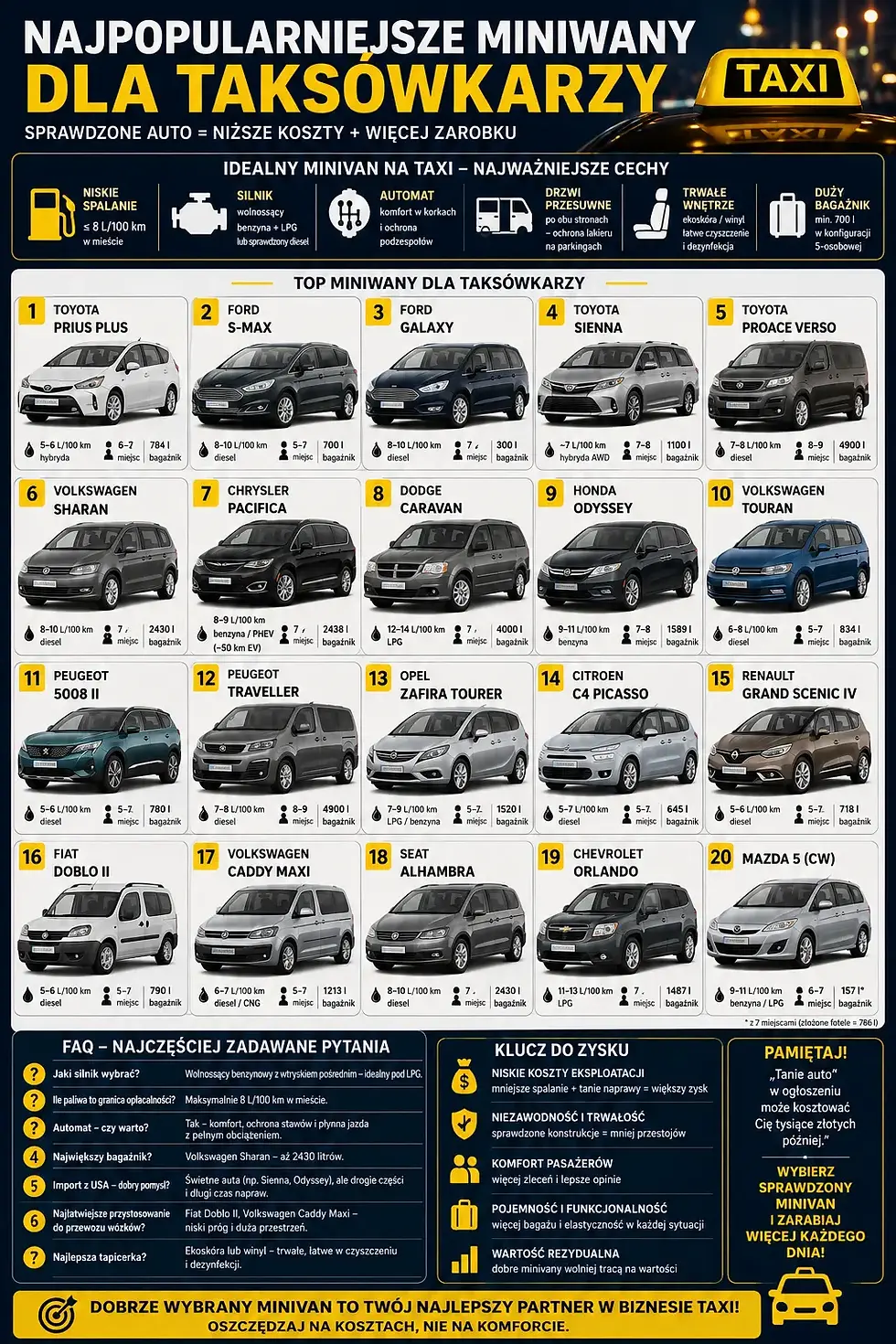
The ideal minivan for taxi use consumes a maximum of 8 liters of fuel in the city and is based on a naturally aspirated petrol engine connected to a sequential LPG system.
This configuration drastically reduces operating costs and eliminates the risk of expensive equipment failures that plague modern diesel engines . Automatic transmissions are becoming a market standard, relieving the strain on drivers' joints during long shifts in traffic jams.
Armored interior and sliding door logistics
The presence of sliding door frames on both sides of the body physically blocks paint damage to adjacent vehicles on narrow driveways. Fleets are purchasing aftermarket minivans available only with vinyl or thicker faux leather upholstery.
Synthetic coatings allow the driver to remove fluids and disinfect the seat in seconds using strong chemicals and microfiber.
Toyota Prius Plus: Functionality and Maintenance Costs
The Toyota Prius Plus outclasses the competition in the van segment as the cheapest multi-passenger vehicle on the market.
This reputation is based on a maintenance-free hybrid system that physically eliminates the most vulnerable and expensive components. Mechanics don't replace the dual-mass flywheel, starter motor, or alternator—Japanese engineers completely eliminated them from the design.
What the Prius Plus offers
The drive is based on a 1.8-litre naturally aspirated petrol engine, coupled to an electric motor via an e-CVT continuously variable planetary gearbox.
As a result, a heavy vehicle consumes on average 5-6 liters of fuel per 100 kilometers in congested urban areas.
Practice shows that the original traction battery retains its nominal capacity without any problems for at least 300,000 kilometers of rigorous operation on taxi shifts.
Key features of the Toyota Prius
The vehicle can physically accommodate six passengers , including the driver, utilizing two emergency seats cleverly stowed in the cargo area floor. Folding the third row of seats provides 784 liters of free, regular space with a perfectly flat floor.
It's not just a matter of cutting costs at the gas station. Maintaining value is equally important – this model has the lowest resale value depreciation of any car in its class studied.
Ford S-Max and C-MAX: comfort and driving characteristics
The Ford van family – the full-size S-Max and the smaller C-Max – sets market standards for driving precision in commercial vehicles.
The stiff multi-link suspension guarantees traction reminiscent of low-slung sports models. The company built it in Europe specifically for the stable and dynamic handling of European intercity routes.
Why the Ford S-Max and C-Max are the family's choice
The key to its ergonomics are fully independent, deeply contoured seats with individual adjustments for each rear passenger. The Ford S-Max easily accommodates full-sized adults over long distances.
The cabin dimensions in the smaller Ford C-Max brutally verify these possibilities, limiting comfortable transit to a maximum of four passengers.
Key features of Fords
Carriers are massively relying on the rugged 2.0 TDCi diesel engine, which has a lifespan of 400,000 kilometers without a major overhaul. The trunk of the five-seat S-Max swallows a whopping 700 liters of cargo in its base configuration.
However, exceeding the 250,000 kilometre barrier is a moment that generates high costs of regenerating the clogged DPF particulate filter and expensive injectors in the common rail system.
Ford Galaxy: comfort and driving characteristics
The Ford Galaxy is the brand's flagship van, whose significantly raised, almost rectangular roofline brings its shape much closer to that of classic delivery vans.
This body architecture dramatically increases headroom in all rows. This allows passengers taller than 190 centimeters to travel comfortably without hitting the headliner.
Why Galaxy is the family's choice
The last two seats in the third row offer enough width to accommodate adult passengers for a comfortable, long-distance journey.
The vertical alignment of the walls and doors facilitates collision-free entry in tight parking spaces. Even with a full complement of passengers, the cargo bay maintains a very usable 300 liters of fixed base capacity.
Key Features of the Ford Galaxy
A diesel engine coupled to a six-speed manual transmission provides the most reliable powertrain for a commercial vehicle. Fuel consumption for a loaded vehicle is typically within a safe range of 8-10 liters of diesel fuel .
The catch is that the enormous curb weight – starting from a level of 1,750 kilograms – degrades and wears the front suspension pins extremely quickly.
Toyota Sienna: spacious and reliable
The Toyota Sienna is a US- designed colossus renowned for its outstanding, almost armor-plated structural durability.
The car is not offered by the brand's European dealership network at all. It reaches local roads only through laborious private importation directly from North America .
What makes the Toyota Sienna stand out on the market?
Modern generations leave the factories only with an advanced hybrid drive based on a naturally aspirated 2.5-liter petrol engine.
This system allows the vehicle, weighing a staggering 2,100 kilograms, to achieve an average city fuel consumption of just 7 liters of gasoline. A rare bonus among vans on European roads is the factory-fitted, fully permanent AWD four-wheel drive system.
Toyota Sienna Features Overview
The factory Driver Easy Speak microphone system picks up the driver's voice from the headliner and transmits it in real time to the rear passenger audio system.
The heavy side doors are powered by an electric motor hidden in the bodywork, which responds to signals from the keyless entry remote. Stowing the rear seat backrests and cushions in a special floor channel reveals a perfectly flat floor with a volume of 1,100 liters .
Toyota Proace Verso: comfort and driving characteristics
The Toyota Proace Verso shares its floor architecture with powerful, strictly commercial vehicles produced by the Stellantis holding's factories.
This full-size model has official road approval allowing it to transport up to 9 adults .
Why the Toyota Proace is the family's choice
Captain's chairs installed on aluminum rails allow for instant meetings by arranging all seats face-to-face.
A perfectly flat floor along almost the entire length of the cabin drastically reduces the risk of tripping for passengers trying to sit in the last row.
Key features of the Toyota Proace
The heart of the drive is the proven French 2.0 BlueHDi diesel engine, designed by engineers with mileage well in excess of 500,000 kilometers in mind.
A major problem for fleets is the seizing pumps that deliver the AdBlue, a highly crystallizing wastewater treatment fluid, to exhaust gas reduction systems. The eight-speed automatic transmission efficiently reduces sudden RPM fluctuations and vehicle jerking when fully loaded.
Toyota Verso: reliability and functionality
The compact Toyota Verso falls into the tight C segment , which is why airport transfer fleets generally avoid it. It has the absolute shortest wheelbase in this comparison.
This design, however, is not accidental – it makes it easier for drivers to aggressively maneuver in heavily congested urban infrastructure.
What makes the Toyota Verso popular
The main motivator for the purchase are the failure-free Japanese petrol engines from the Valvematic family with a displacement of 1.6 and 1.8 liters .
The lack of complicated, direct fuel injection in the cylinder head allows for exceptionally cheap and completely safe installation of popular LPG gas systems.
Key features of the Toyota Verso
The type approval coded 5+2 clearly states that the two seats pushed into the trunk are emergency and are only suitable for children due to their size.
A loaded car trapped in city traffic consumes about 10 liters of LPG per 100 kilometers. The company removed this model from the production line at the end of 2018 , leaving only the option of hunting for second-hand units on the table.
Honda Odyssey: Comfort and Space
The Honda Odyssey is a Japanese van rigorously designed to silently absorb hours of highway driving. Engineers installed thicker side windows that physically isolate the cabin from wind noise.
Why the Honda Odyssey is popular in the USA
At the heart of the drivetrain is a powerful, naturally aspirated 3.5-liter V6 gasoline engine. The catch is that the unit features an electronic VCM system that brutally cuts off injection in some cylinders when cruising at a constant speed, reducing fuel consumption.
The cabin is upholstered in hard and completely scratch-resistant plastic, and the seats are covered with armored, synthetic leather.
Honda Odyssey Main Advantages
The Magic Slide floor channel system forces the middle row seats to slide sideways, freeing up a wide passage to the rear of the vehicle.
Road collisions on European roads carry enormous logistical costs. A damaged body requires the import of expensive spare parts directly from dealerships in North America .
Additionally, installing an LPG system is financially complicated, as servicing six cylinders requires the use of non-standard, dedicated components.
Volkswagen Sharan: Solidity and Spaciousness
The Volkswagen Sharan and its Spanish technological clone , the SEAT Alhambra, are based on a rectangular architecture with an almost complete lack of roof truncations.
The boxy design creates the largest buffer of empty space in the segment directly above the heads of rear-row passengers.
Why the Volkswagen Sharan is often chosen
Rear doors suspended on sliding clamps drastically reduce paint bills for parking lot scuffs. Seats molded from dense, stiff foam provide excellent damping and vibration absorption when driving on damaged city streets.
Aligning the backrests in the second and third rows creates a table-like loading surface with a gargantuan capacity of 2,430 litres .
Key features of the Volkswagen Sharan
The position of the most profitable drive in operation is maintained by the proven 2.0 TDI engine producing a constant 150 horsepower .
Odometer readings above 200,000 kilometers usually mean the end of the road for DSG dual-clutch gearboxes – the control module then requires comprehensive and very expensive regeneration.
The TSI family of petrol engines operates on direct fuel injection, which skyrockets the base costs of adapting the system to natural gas.
Chrysler Pacifica: Luxury Features and Spaciousness
The Chrysler Pacifica is marketed as a luxury capsule for discreet business travel and the most expensive hotels. The hybrid PHEV variant addresses the prohibitive parking costs in city centers. The mechanism guarantees a range of approximately 50 kilometers based solely on stored electric power.
What the Chrysler Pacifica offers
Passenger usability is defined by the Stow'n Go mechanism, which stows the full-size seats directly under the floor panels.
The manufacturer has equipped the second row with electric heating mats and even ventilation. For those who care about perfect cleanliness, the trunk walls house a built-in central vacuum cleaner designed for cleaning during airport layovers.
Chrysler Pacifica Key Features
The classic petrol version is based on the indestructible and easy to service 3.6 V6 Pentastar block.
The nine-speed automatic gearbox reduces engine revs very aggressively, effectively isolating the driver from vibrations generated at high speeds.
The real surprise lies in the chassis – the front suspension components come off the production lines in Europe , which significantly shortens the waiting time for mechanical repairs.
Dodge Caravan / Town&Country: Spaciousness and Functionality
The Dodge Grand Caravan and its platform-sharing Chrysler Town & Country are proven, older platforms built on durable chassis. The manufacturer deliberately stripped them of advanced electronics. As a result, these devices can be repaired quickly and affordably at any independent repair shop.
What Makes the Dodge Caravan Popular
Cars from the production lines until 2016 dominate as the absolutely cheapest market options in the seven-seater category.
The widely installed 3.6 Pentastar engine guarantees complete resistance to block overheating under one strict condition: rigorous oil changes in the aluminum housing. The extremely simplified wiring harness allows mechanics to diagnose and repair physical wiring damage at a pace unattainable by European competitors.
Dodge Caravan Key Features
American cruisers with LPG systems installed consume on average between 12 and 14 liters of gas per 100 kilometers .
Removing the Stow'n Go seat mechanism opens up an unimaginable 4,000 liters of empty cargo space. The design's critical point is the severely undersized brake discs, which instantly burn out and warp under the van's maximum passenger load.
Kia Carnival: Spaciousness and Comfort
The Kia Carnival breaks away from the styling of curvy vans, adopting an angular body shape visually inspired by SUVs . The fourth-generation vehicle, manufactured in South Korea, has gained an open, official dealership network in European markets.
What Makes the Kia Carnival Stand Out in the Market
In some configurations, the vehicle is approved for up to 11 seats mounted in four floor rows.
The interior is designed around the "Premium Relaxation" concept, providing passengers with electronically controlled footrests and ventilated seats with a relaxation function.
The vehicle boasts seven years of written service coverage, minimizing unexpected strain on the company's wallet. Unfortunately, the current generation is not available in Europe.
Key Features of the Kia Carnival
The main power source for the commercial models is a turbocharged 2.2 CRDi diesel engine, generating an even 202 horsepower . Diesel fuel consumption in urban areas hovers around 8 liters, despite the considerable external dimensions.
The low supply of used and cheap body parts complicates post-accident repairs, increasing insurance settlement rates after side impacts.
Mercedes Vito: Comfort and Spaciousness
The Mercedes-Benz Vito is a highly durable commercial van with sprinter genes, designed from scratch with airport transfers and VIP customer service in mind, but only in the V-Class version .
Versions based on the legendary 2.1 CDI engine usually exceed the 500,000 kilometre barrier without the need for mechanics to touch the block as part of a major overhaul.
Why the Mercedes Vito Class is the choice for families
This utility vehicle is gaining a second life as a base for large families in a powerful Tourer configuration. The interior accommodates separate, full-size seats for nine passengers .
The flat floor with built-in aluminum rails gives the user the freedom to physically move or completely dismantle individual rows in minutes.
The optional double sliding doors are a lifesaver in crowded parking lots – they brutally reduce the risk of inattentive children damaging the paintwork of neighboring cars.
Overview of the Mercedes B-Class's functionality
The Mercedes-Benz B-Class operates in the city taxi market, based on a compact, monocoque body. This architecture physically facilitates drivers' aggressive parking in dense urban environments. Engineers have incorporated proven front-wheel drive into the vehicle.
This solution frees up valuable legroom for rear-seat passengers. The standard trunk capacity of the 5-seater variant stops at a promising 488 liters , which is more than enough to accommodate two large flight cases.
Peugeot Traveller: Spaciousness and Modern Technologies
The Peugeot Traveller is tackling the market for powerful French minibuses with automated, touchless side doors.
The integrated Grip Control traction control system provides direct driver support on steep, sandy and icy climbs.
Why Peugeot Traveller is a modern choice
The advanced safety package in this vehicle is based on the Active Safety Brake automatic emergency braking system. An electronic Head-Up Display projects key speed parameters directly onto the windshield, perfectly in the taxi driver's line of sight.
The 3D navigation system installed in the cockpit recognizes native human voices. Drivers can enter additional pickup points without physically taking their hands off the wheel.
Peugeot Traveller functionality overview
French diesel engines marked with the code 2.0 BlueHDi generate a maximum power of 180 HP , while consuming just 7 liters of diesel fuel in the combined cycle.
The modularity of the cabin is based on a simple mechanism - dismantling the seats in a standardized 2/3 - 1/3 arrangement converts the passenger taxi into a cargo area with a terrifying volume of 4,900 liters .
Second-row passengers have access to a completely isolated air conditioning system with its own panel built right into the headliner.
Volkswagen Touran: Solidity and Functionality
The compact Volkswagen Touran dominates market rankings for the lowest suspension failure rate when hitting city manholes. The ubiquitous presence of the 1.6 TDI and 2.0 TDI engines on markets and in classifieds means one thing: garages have completely unlimited access to the cheapest replacement parts.
What makes the Volkswagen Touran stand out?
The car's chiseled, boxy body shape generates a huge air reservoir directly above the heads of passengers taller than 190 centimeters .
Short overhangs and a total length of 4.52 metres make it easy to change lanes and squeeze the car into tiny gaps at taxi ranks.
The dashboard architecture is an exact copy of solutions taken from the base Volkswagen Golf , which radically reduces the time needed to introduce new employees to the fleet.
Key features of the Volkswagen Touran
The main transport weapon here is the three, completely independent second-row seats equipped with dedicated ISOFIX mounts. The classic five-seat configuration provides a sensible and deep trunk with a capacity of 834 liters .
A critical obstacle in the transport business becomes when the emergency seats for the seven-seater are removed. The usable trunk then shrinks to a paltry 137 liters .
Volkswagen Caddy: Spaciousness and Low Maintenance Costs
The Volkswagen Caddy, equipped with the extended Maxi body, is a typical, rugged workhorse, combining seven-seat capacity with a spacious trunk. Taxi drivers readily accept the tough, armored, and highly scratch-resistant cast materials used in its dashboard.
What makes the Volkswagen Caddy stand out?
The model adapts the architecture of a classic delivery van. This engineering move dramatically increases the maximum payload and the longitudinal strength of the body.
The rear axle rests on clunky leaf springs, preventing the suspension from bottoming out under the maximum load of several suitcases.
The design simplicity, devoid of bells and whistles, reduces the man-hours spent by mechanics in unauthorized workshops by almost 30 percent .
Key Features of the Volkswagen Caddy
TGI variants with factory-installed compressed natural gas installations maximise the profitability of every intercity route.
The side doors were deliberately stripped of their electronic sliding assistance for one specific purpose – the absence of small motors ensures the hatch will open even in extreme frost. The architecture of the extended version adds 3,006 millimeters to the wheelbase.
This difference physically provides acceptable legroom for passengers crammed into the third row.
Seat Alhambra: Spaciousness and Functionality
The Seat Alhambra is a direct, Spanish-made technological clone of the popular Volkswagen Sharan van. Beneath the sheet metal lies the global Volkswagen AG platform, guaranteeing unprecedentedly cheap and quick access to used body parts from local salvage yards.
What the Seat Alhambra offers
The rear compartment's design allows for flexible cargo handling ranging from a starting volume of 267 liters to a massive 2,430 liters . The Spanish minivan blows air onto passengers from dedicated nozzles connected to its own, autonomous Climatronic zone.
Sliding rear door frames protect the hard paintwork from mechanical damage from customers rushing out of the vehicle in tight parking spaces. Laying the right front seat flat on the floor opens a long tunnel for emergency transport of profiles measuring 2.95 meters in length.
Key Features of the Seat Alhambra
Individual backrest variants feature built-in booster systems for the youngest. In practice, this means legal transportation of minors without the need to waste time attaching external seats.
The suspension system, packed with DCC active shock absorbers, forces the driver to hard and manually recalibrate the damping stiffness right after loading a full set of passengers.
The powerful 2.0 TDI diesel engines are coupled with lightning-fast DSG dual-clutch gearboxes, dramatically relieving the strain on the joints of the left leg in afternoon traffic jams.
Citroen C4 Picasso: Modern Design and Functionality
The Citroen C4 Picasso and its long-frame Grand C4 Picasso variant strikingly undercut market fuel consumption standards with their powerful 1.6 HDi and 2.0 HDi engines. The French bodywork boasts a massive amount of glass, enhancing the visual appeal of paid excursions.
What makes the Citroën C4 Picasso unique?
The smooth, remarkably streamlined roofline cuts through the air, effectively cutting the level of tire noise in the cabin during highway transfers above 120 km/h .
Moving the digital dials from behind the steering wheel to the center console gives the driver instant readability on tired night shifts.
The semicircular windscreen, which extends deep into the roof profile, opens up visibility to the often obscured traffic lights hanging directly above the intersection.
Citroen C4 Picasso interior review
The Lounge package adds a wide, electrically extendable footrest to the front passenger seat – an option that allows for a deep, relaxing position when logging long commutes. However, these innovations come with operating costs.
The rear axle air springs in top-of-the-line models are prone to costly repairs, typically leaking after 150,000 kilometers . The lack of physical controls for the blower forces the driver to adjust the temperature with precise finger taps on the 7-inch touchscreen .
Opel Zafira: Functionality and Maintenance Costs
The Opel Zafira tops the list for affordable and trouble-free operation thanks to a strong supply of cheap replacements from Asia . The vehicle's physical weight, which exceeds 1,600 kilograms, causes accelerated wear of the brake discs and pads.
Why is the Opel Zafira popular in Poland?
The Opel Zafira bases its market success on a drive architecture that is extremely simple and extremely cheap to repair.
The 1.4 Turbo petrol engine operates on proven multi-point indirect injection, which physically opens the way to cost-effective installation of even the simplest sequential LPG systems. Taxi drivers make cool calculations every day.
A massive nationwide network of authorized dealers and unauthorized workshops repairing Opel vehicles drastically reduces machine downtime after collisions at city intersections.
Key technology features in the Opel Zafira
The equipment configuration marked with the commercial symbol Tourer implements the original Flex7 seat mechanism into the interior.
The system forces the third-row seats to retract completely flush with the cargo floor with the physical pull of a single lever. The designers ruthlessly sliced the middle seat into three fully independent seats.
They are mounted on rigid guides, with a longitudinal adjustment range of a whopping 210 millimeters . This isn't just about changing the backrest angle. The real difference is made by a feature that allows the outer seats of the second row to be pushed firmly into the cockpit immediately after removing the center seat.
This operation pumps up shoulder space, arranging executive conditions for two passengers being picked up from the airport.
Chevrolet Orlando: Spaciousness and Functionality
The Chevrolet Orlando, advertised on the stock exchange, is a highly affordable transportation option in the class of cars capable of seating up to 7 people . Its clunky, simple-carburetor-powered petrol engines are remarkably patient, enduring the rigors of daily life on LPG- powered delivery vans.
The sharply cut, box-like shape of the roof deliberately rejects rounded trends. The profile thus frees up dozens of centimeters of airflow directly above the heads of customers entering the car.
What exactly does the Chevrolet Orlando offer passengers?
The massive bodywork, on a scale of one, mimics the stark proportions of powerful SUVs . This amount of thick sheet metal instantly boosts nighttime travelers' psychological sense of security from road rage.
The naturally aspirated engine block, cut to a 1.8-liter displacement, produces a consistent 141 hp . Engineers incorporated a completely non-stretchable steel timing chain, eliminating the need for mechanics to perform tedious belt repairs.
The cabin was designed with a sense of aesthetics in mind. The USB charging port and a handy storage compartment are built directly behind the mechanically tilting front radio panel, concealing the endless coils of cabling for the taximeters.
Chevrolet Orlando luggage capacity overview
Maximum cabin load and all seven seats in place create a microscopic recess in the cargo area with a volume of exactly 89 liters . This single, ruthless parameter immediately eliminates the tested machine from the competition for profitable resort baggage transfers.
Gluing the backs of the middle and last rows into one flat floor unlocks the regular capacity swallowing up as much as 1,487 liters .
However, using the American fleet constantly messes with supply logistics. The official deregistration of Chevrolet 's commercial branches in European countries fuels a critical shortage of original bodywork components.
Peugeot 5008 (2nd generation)
The second iteration of the Peugeot 5008 forcefully crams the laid-back functionality of vans into the popular, massive SUV styling. The second row features a rigorous division, providing passengers with exactly three independent seats , each with its own ISOFIX restraint systems.
Why the Peugeot 5008 design is a very modern choice
The heart of the city's economic viability lies in the 1.5 BlueHDi engine. This miniaturized diesel engine averages just 5-6 liters of fuel per 100 kilometers of rough, mixed driving.
The market advantage becomes apparent the moment the vehicle doors open. The i-Cockpit's expansive interior architecture, featuring screens, enhances the passenger's perception of the purchased service. This recognition immediately returns to the driver in the form of higher ratings in ride-hailing apps.
Peugeot 5008 emergency functions overview
The highly shapely shape of the luggage area can handle a rigorous 780 liters of load when operating in the 5-person variant.
The driver quickly arranges gigantic reinforced suitcases in the back, completely bypassing the problematic removal of the seats.
The factory-installed third row of rarely used seats, sunk under the floor, allows for occasional and legal transport of up to 7 people , saving fleets during weekend marathons with large team-building events.
Renault Grand Scenic IV and Espace V
The French-built Grand Scenic and Espace models outperform their lumbering rivals by implementing an expensive, proprietary adaptive suspension system.
The factory also thought through the mounting of the passenger area, giving drivers a very wide range of options in modifying the rail-mounted seat settings.
Why Renault designs save the home budgets of fleet owners
The main drivetrain is based on a 1.6 dCi engine, rebuilt and tuned by the workshop. The system delivers the optimal amount of torque to the pavement needed to pull a full car away from the traffic lights, combined with extremely cheap bodywork parts scattered across aftermarket platforms.
Operating the seven-passenger versions can often be an organizational headache. The mechanics implemented a solution called One-Touch in the bodywork. You press a button soldered into the trunk, and a chip automatically folds the rear seatbacks down to precise ninety-degree angles.
Key glass and storage compartment functions in Renault cars
The vast expanse of hard glass stretching along the roof provides the driver with dreamlike visibility in built-up areas. This sea of glass completely shatters the feeling of being trapped in a tight can for the suffocating rear passengers.
The front panel, covered with solid material, conceals an ingenious network of recessed compartments. Their combined depth easily exceeds 60 liters , providing a secure hiding place for unnecessary coffee stains, loose documentation, and small change from cash register terminals.
Fiat Doblo (2nd generation)
The genetics of the Fiat Doblo model bring to the market a raw design, laying the foundation for the lowest hatch loading sill on the market.
The huge, sheet metal cubic capacity makes the car immediately shine in the zone of the most difficult to carry out strictly municipal transport.
Why the raw Fiat Doblo is flooding the companies of drivers en masse
The in-line unit produced under the die-cast 1.6 MultiJet banner has already achieved the rank of a real killer in the league of oil-burning engines.
The engine easily handles the thermal stress of jerky, rev-happy driving over cobblestones. The rear beam system completely eliminates the need for emergency multi-link springs.
Putting the car on a rigid steering axle and adding heavy springs reduces the bills at the gates of mufflers and chassis painters by a full half.
Overview of modifications to the Fiat Doblo's communal spaces
The sweeping, upward-sweeping roofline offers taller customers the deepest airspace of any station wagon produced this year. Extremely tall people can enter straight ahead.
The spacious rear of the vehicle encourages craft workshops to invasively cut out rear doors. Adapting the entire axle and creating a transport ramp for the transportation of wheelchair users generates requests from municipalities for the most expensive rides in the city.
Mazda 5 (CW)
The Mazda 5 counters European dominance with its exceptionally strong, roller-guided, sliding rear side hatch doors.
This solution, harsh in elimination and effective, ultimately nips the problem of minors banging metal sheets into neighboring cars at the entrances to the shopping mall.
Why the petrol Mazda 5 suits drivers with a sporty streak
The powertrain offer includes 2.0 -liter gasoline-burning engines that launched a series of Japanese eco-friendly ideas called SkyActiv .
The lack of a turbocharger and the eliminated exhaust complications free the corporate boss from clogging up with slag and replacing expensive DPF filter inserts during cold weather. The entire suspension setup rests on rigid pivots.
You steer with precision. The body's responsiveness puts sluggish French minivans to shame, facilitating hours of forced lane changes for experienced taxi drivers.
Overview of original configuration tricks in the Japanese Mazda 5
The company's signature Karakuri built-in seating arrangement system allows for rapid rearrangement of the entire compartment, moving from a loaded 7 -seat setup to a flexible 6. A quick ejection of the middle seat gives passengers a smooth transition to the rear seat, which is ejected all the way to the hatch.
SkyActiv engine manufacturers have built an ingenious base for cylinders. After combining the injectors with reducers of brand-name LPG system circuits, the engines reduce daily expenses by a whopping 50% .
FAQ: Which minivan for a taxi and family car should I choose from the used market?
Looking for a car that will truly earn its keep while parked, and will also serve as a large family car after hours? Learn the specifics and technical nuances of fleet management that will simplify your selection on the used car market .
What are the most recommended engines for passenger transport? : The optimal choice on the used minivan market is a naturally aspirated or proven indirect injection petrol engine (e.g., in the Opel Zafira ), providing an ideal base for inexpensive LPG installations. Modern and complex diesel engines pose a significant financial risk due to clogged filters in urban environments.
What average fuel consumption guarantees profitability in a taxi? : The hard line for operating profitability is 8 liters in the urban cycle. This is why drivers cut operating costs by choosing a petrol engine paired with a sequential LPG system.
Is an automatic transmission in a van an unnecessary luxury? : Absolutely not, as the automatic aggressively reduces jerking when the vehicle is fully loaded and physically protects the driver's joints from degradation during long shifts in traffic jams.
Which minivan for a large family can cope with night shifts? : An excellent compromise, combining the features of a commercial taxi and a spacious family car , is the Volkswagen Touran or the hybrid Peugeot 5008 , where the emergency third row of seats quickly folds flat.
Which minivans available in classifieds offer the largest airport trunk? : Filtering the secondary market in this class, the absolute leader in cargo capacity is the Volkswagen Sharan , swallowing an equal 2,430 liters of suitcases on a completely flat floor.
Which Ford minivan is the most reliable on fast roads? : The flagship Ford S-Max and the stripped-down Ford C-Max outclass their rivals with the traction of a stiffened sports car. However, the price for this comfort is the lack of sliding doors, a feature so successfully found in Asian rivals like the Kia Carnival and the Japanese Mazda.
Is importing seven-seater vans from the US a good business idea? : Armored models like the Toyota Sienna or the well-soundproofed Honda Odyssey are perfect highway vehicles, but every fender bender requires weeks of importing expensive parts straight from North America .
Why is the seemingly cheaply priced Chevrolet Orlando a risk? : This car's engines handle the cheapest gas perfectly, but the official evacuation of the brand from Europe has created a huge shortage of bodywork parts, which disqualifies this car regardless of whether you're aiming for the base or the facelifted minivan .
Will smaller, narrower vehicles earn their keep in the tight city center? : The compact Mercedes B-Class and the boxy Opel Meriva maneuver through residential areas with the precision of a scalpel, and the removal of front-wheel drive frees up precious centimeters on the seats for passengers' knees.
Which platforms are the cheapest to adapt for wheelchair transport?: The lowest loading threshold from a ramp is offered by sheet metal station wagons – the vertical Fiat Doblo II (as well as the older Fiat Doblo ) and the extremely elongated Volkswagen Caddy .
What do mechanics advise to watch out for when buying modern vans from France? : The advanced and glazed Citroen C4 Picasso provides incredible suspension comfort, but the pneumatic bellows of the rear chassis, which break on potholes, can cost thousands of zlotys just after exceeding 150,000 kilometers .
What upholstery will survive damage and reduce fleet costs? : When studying the technical data and equipment of the car, definitely reject velour – look for seats finished with synthetic eco-leather, in which the removal of dirt or sterilization requires only the use of an absorbent microfiber.


Comments