
The Ryanair Story: How the Low Cost Powerhouse Came to Be

Ryanair didn't become cheap by accident—it became ruthless. Before you even bought your first ticket for a few dozen złoty, the company was burning through millions on absurd ideas, business class, and operational chaos.
Only brutal cuts, one decision and one man turned it into a money printing machine.
See how financial disaster created the biggest predator in the European skies—and why its model works better than you'd like to admit.

Founding of Ryanair by Tony Ryan
Before the Irish carrier imposed its own ultra-low-cost (ULCC) model on the entire continent, it had to survive an extremely brutal phase of market experimentation.
The company's beginnings required enormous determination, and the path to profits was paved with very expensive mistakes.
What exactly were the company's beginnings like in 1984?
The foundations for its current power were laid in the mid-1980s, when Tony Ryan decided to expand into the passenger transport market.
Unfortunately, instead of a smooth start, the fledgling organization experienced extremely heavy operational losses.
Take a look at how the early and bumpy timeline unfolded:
1975: Irish entrepreneur Tony Ryan lays the foundations for his business by founding the leasing company Guinness Peat Aviation (GPA).
November 1984: The company "Danren Enterprises" is officially registered with a small initial capital of £1.5 million (the founders included Tony Ryan, his sons Declan and Cathal, and Liam Lonergan).
1985: Historic and pivotal name change to Ryanair.
1985–1987: Eugene O'Neill is appointed as the first chief executive officer (CEO). The company suffers losses due to poor cost management.
September 1987: O'Neill was brutally dismissed from his position. It was a political matter – the CEO wanted to take the state-owned airline Aer Lingus to the European Commission, something Ryan, completely dependent on the Dublin government's license, could not agree to.
Historic first flights from Waterford to London Gatwick
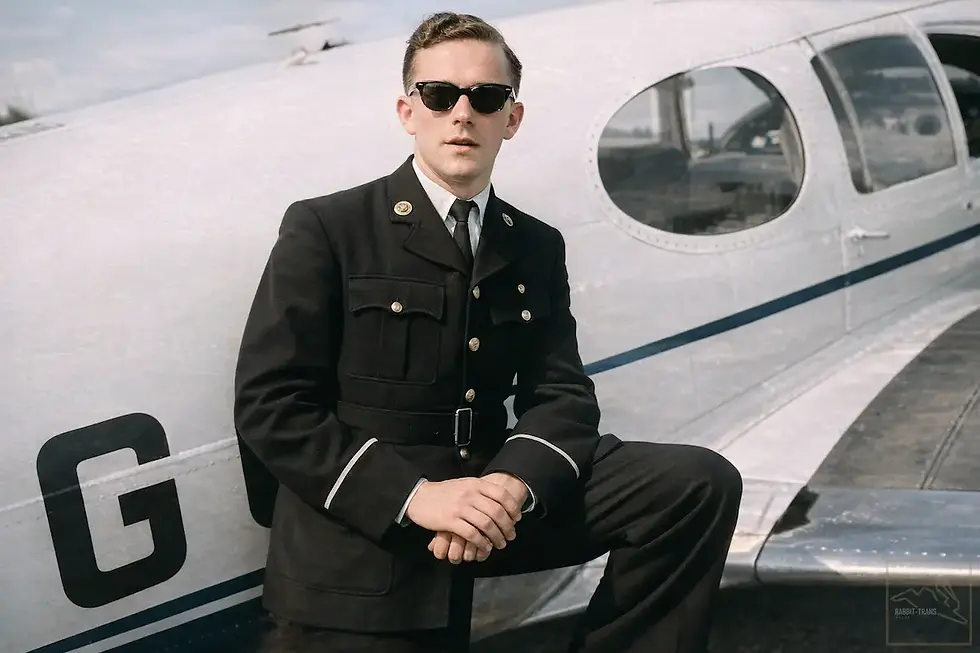
The real baptism of fire in the air took place on July 8, 1985, when the route from Waterford, Ireland, to London Gatwick Airport was launched with great fanfare.
The carrier's fleet was at that time downright microscopic , as only one 15-seat turboprop Embraer EMB 110 Bandeirante took to the skies.
Interestingly, the airline employed a total of 25 staff and maintained an absurdly restrictive recruitment requirement – due to the cramped space of the aircraft, cabin crew could be a maximum of 152 cm tall .
The year 1986 brought the long-awaited breakthrough. The company purchased two 46-seat Hawker Siddeley HS 748 aircraft and opened the Dublin–London Luton route.
“By offering an unbeatable fare of £99, Ryanair immediately broke the tight duopoly of Aer Lingus and British Airways, carrying a staggering 82,000 passengers in a year.”
Early fleet and service experiments
Before the company found its low-cost identity, it searched rather chaotically for the optimal model.
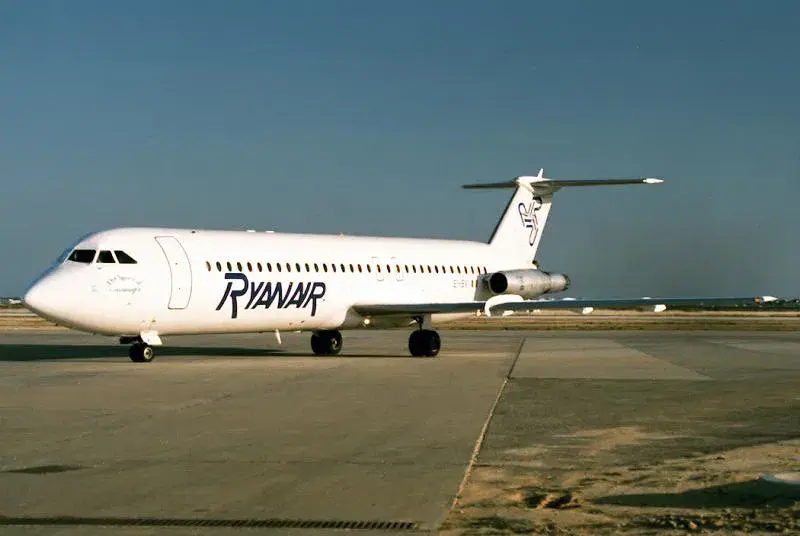
In 1987, BAC 1-11 jets were added to the network, followed shortly after by French ATR 42-300 machines.
Just think – the same carrier that today makes you pay extra for millimeters in your luggage, in 1988, unusually offered its customers a luxurious business class and a frequent flyer program!
These completely misguided luxuries generated a massive loss of nearly £20 million and were ultimately liquidated just twelve months later.

Development under the Direction of Michael O'Leary
The true organizational and financial revolution came only with a change in command. The arrival of a completely ruthless and pragmatic visionary forever changed the landscape of aviation in Europe.
How did the transformation into the largest low-cost carrier take place?
The transformation from a fading start-up to the undisputed low-cost leader began in 1988. That's when Michael O'Leary, a brilliant tax advisor from the renowned firm KPMG, joined the organization as deputy CEO.
The paradox is that at the very beginning he absolutely recommended closing down the entire loss-making business.
Here are the most important milestones of this great transformation, arranged in a clear timeline:
1991: O'Leary travels to the US, where, under the guidance of the legendary Herb Kelleher, he explores the highly effective cost-cutting model at Southwest Airlines.
1994: As the new CEO, he begins a ruthless restructuring: overnight he cuts the flight network from 23 routes to just 4, moves the main base to the cheap London Stansted and with iron consistency implements the "no-frills" model (zero free refreshments, maximum machine speed).
April 1997: The final entry into force of the EU's third liberalisation package frees up the hermetic market, allowing the Irish to operate cabotage flights freely within the EU.
1997: A massive IPO in its native Dublin and on the mighty NASDAQ in New York pumps a flood of capital into the company, allowing for aggressive expansion from regional ports (including Skavsta, Torp, Beauvais, and Charleroi).
Introduction of the unified Boeing 737 model
Gaining dominance required a rapid restructuring of its technical resources. In 1994, the company purchased its first six used (130-seat) Boeing 737-200 aircraft, systematically expanding the fleet to a total of 21.
However, the absolute breakthrough took place in 1998 with the placing of a historic order for 45 new Boeing 737-800 aircraft worth a staggering $2 billion.
In 2002–2003, O'Leary demonstrated top-tier business engineering—he ruthlessly capitalized on the market slump following the September 11 attacks and ordered a final order of 250 of the latest aircraft, reaping discounts exceeding 50% . Ultimately, the holding company paid less than $45 million per unit.
Ryanair fleet
Maintaining a strictly uniform fleet is an unquestionable tenet of any low-cost carrier. It's by sticking to a single manufacturer that the company is able to generate margins unattainable by companies that mix European and American aircraft.
Why does optimization by unification work so well?
Using a single, standardized aircraft type across the fleet cuts significant costs across three key pillars. Where agile organization intertwines with smart logistics, the greatest reductions in operating costs occur.
Personnel Training: All cockpit and cabin crew undergo identical training (type rating), which dramatically reduces licensing fees and facilitates the construction of complex leave schedules.
Cheap Maintenance: The use of a centralized repair and diagnostics system dramatically reduces the inventory of expensive spare parts.
Network Flexibility: Any spare aircraft from the reserve immediately and without hesitation replaces a broken aircraft on a specific route, saving the plan from chaos and expensive compensation for passengers.
Main operating models: Boeing 737-800 and Boeing 737 MAX
The iron, indestructible backbone of the group for nearly two decades has been the Boeing 737-800 NG equipped with the famously reliable CFM56-7 engines (their failure-free rate is around 99.95%).
As of late April 2024, 618 of this aircraft were flying in the network. However, the future rests uncompromisingly on the newer version – the Boeing 737-8200 MAX (known as the "Gamechanger").
It burns 16% less valuable fuel, reduces noise by as much as 40%, and seats 197 value-for-money passengers . In the FY25 fiscal year, the carrier relied on 176–181 of these aircraft.
Future plans: Boeing 737-8200 MAX and Boeing 737-10 MAX
Major expansion must be based on sustainable financing. The holding company anticipates massive capital expenditures (CAPEX) of an astronomical $22 billion by 2034.
An impressive order for a total of 300 Boeing 737-10 MAX enlarged models has already been placed (including 150 fully confirmed for production).
They will reduce fuel consumption by 20% compared to the classic NG and will accommodate a record 228 people on board.
Importantly, basing the entire empire solely on Boeing factories caused massive logistical disruptions at the turn of 2024/2025 – delays in deliveries brutally forced the holding to cut its network by nearly 10 million tickets.

Expansion and Subsidiaries
Effectively managing a market growing at double-digit rates forced a shift away from the simple, single-entity model. In 2019, the large parent company (Ryanair Holdings plc) was separated and surrounded by sister companies focused on legal optimization.
Ryanair Sun and its market rebranding to Polish Buzz
The Polish market saw the creation of a dedicated entity in 2017, when Ryanair Sun, eager to expand its charter operations, registered in Poland . Just a year later, it also operated flights under a convenient wet-lease formula.
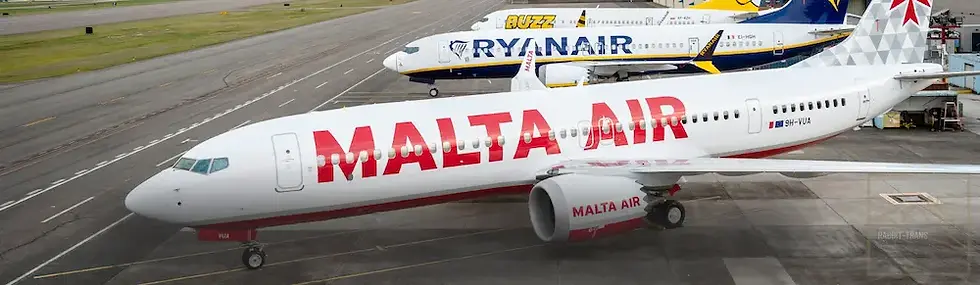
In 2019, it underwent a major rebranding, launching as Buzz. Remember how I mentioned cost reduction? "Buzz" was the name of a bankrupt British low-cost airline formerly owned by KLM, acquired in 2003 for €23.9 million.
The Irish quickly liquidated the former loss-making business of that company, and bought the rights to the catchy brand cheaply and brought them out of the closet specifically for the Polish market.
Lauda Europe and Malta Air as tools of Ryanair Holdings
Companies registered in Malta act as invaluable optimizers within the entire conglomerate.
Established in 2019 in cooperation with the local government, Malta Air benefits from liberal tax laws. This allows O'Leary to easily open routes in Africa and legally protect crews based in countries such as Italy and France from taxes.
Lauda Europe (bought from the ashes of Laudamotion) is a brilliant market anomaly. It is the only airline to successfully break away from the doctrine of homogeneity by operating an exclusively Airbus A320 fleet .
It thus serves as an ideal negotiation tool (scare machine) to soften up the American Boeing during discount talks.

Ryanair Holdings: Structure and Market Impact
The holding's accounting results mercilessly expose the incompetence of market laggards. Aggressive management sets standards so stringent that the rest of Europe's competitors can only admire the figures in its financial reports from Dublin from afar.
Ryanair Group as the largest power in Europe
The Irish are the clear leader in terms of passenger volume on the continent. Unit CASK costs (excluding fuel) hover around a level of 2.5-3.0 eurocents, unattainable for their rivals.
Meanwhile, giants like Lufthansa burn through twice as much (5-7 eurocents). This entire lifeblood encompasses an impressive 3,500 flights per day, located within 95 bases spread across nearly 40 countries.
"The 16% decline in PAT profit (to approximately €1.6 billion in FY2025) was a brilliant tactic – the company deliberately underpriced tickets to fuel high demand. Any losses were masterfully covered by a 10% increase in in-flight sales and ancillary services (Ancillary), which reached €4.7 billion."
Ryanair UK and the Challenges of a Hard Brexit
The prospect of London being thrown out of the European Union threatened to destroy the perfect grid system.
The response was a precautionary application for a local British AOC (Air Operator Certificate) at the end of 2017. Ryanair UK, established shortly thereafter, ultimately saved the enormous profits generated in the lucrative British domestic market.

Operational Bases and Key Airports
The holding company disdains the traditional hub-and-spoke model. Instead, it has offered customers a low-cost point-to-point model, settling on small airports in exchange for stringent cuts in government fees.
What are the bases and centers like in Poland?
The situation on the Vistula River changed dramatically in 2012, after the opening of the famous port inModlin .
A short but devastating price war permanently forced Wizz Air's aircraft out of the country. The main domestic logistics hubs currently remain Warsaw-Modlin, Wrocław, Kraków, Poznań, and Katowice.
The scale of this hegemony is shocking – the report for the first quarter of 2024 shows that the Irish share in our market amounted to a knockout 35.45% , leaving the pink competition (Wizz Air – 26.54%) and the national carrier (LOT Polish Airlines – 16.80%) behind.
In turn, the charter company Buzz comfortably took over a dozen percent of the tourism market.
London Stansted as main operations centre
Although the blue and yellow tails of the planes have taken over all corners of the EU, the London Stansted hub (launched in 1999) reigns supreme as the center of gravity of the entire company.
Further cementing of this location took place in September 2004, following the acquisition and use of the invaluable operating slots of the liquidated Buzz brand.
Significantly, after 2010, management boldly broke its own rules and also entered the extremely expensive primary airports. Bases in Rome (Fiumicino), Madrid, and Copenhagen were established to effectively steal profitable business-class travelers from traditional flagship airlines.
Competition and Market Challenges
If you think airline ticket sales are just about an efficient reservation system, you're dead wrong. It's a relentless war to eliminate smaller players, punctuated by spectacular skirmishes with EU antitrust officials.
Loud battles over Aer Lingus and unequal public aid
At home, the corporation has demonstrated great tenacity, launching three bids (in 2006, 2008 and 2012) for a hostile takeover of its rival, Aer Lingus.
Ultimately, the EU bureaucracy powerfully blocked these attempts, and O'Leary was punished by being ordered to reduce the collected shareholdings to a symbolic threshold of 5%.
However, the real punch came during the pandemic. From 2020 to 2024, a team of top lawyers worked tirelessly to win judgments in the EU General Court blocking bailouts implemented by nation-state governments.
Billions were literally snatched from rivals' noses – €6 billion in subsidies were canceled for the huge Lufthansa and nearly €11 billion for the badly damaged Air France-KLM.
Absolute impact on the low-cost airline market
The holding's driving force is largely based on its powerful iron fleet reserves, which allows it to precisely capitalize on the enemy's momentary stumbles.
A prime example is the image and technical drama of Wizz Air at the end of 2024, caused by serious manufacturing defects in Pratt & Whitney turbines.
While the Hungarians were frantically grounding their Airbuses and closing down their strategic base in Vienna, the predatory giant replaced the cancelled routes with its gleaming Boeings within days.
This brutal rally is illustrated by the closed statistics for 2024: over 197 million passengers transported compared to a rather modest 91.1 million for EasyJet or 62.7 million for the aforementioned Wizz Air.
What controversies and image scandals are associated with Ryanair?
The company is cutting back on almost everything, which is inextricably linked to constant blows aimed at both passengers and staff.
Years of fighting trade unions: The holding company ignored all forms of employee association for 30 years. The stubborn concrete crumbled only with the colossal paralysis of the flight network in the fall of 2017 (resulting simply from a ridiculous IT failure in schedule planning), when the management, fearing a cash outflow, officially signed the first-ever agreements with Fórsa and BALPA.
Free "Earned Media" is riddled with scandals: Avoiding paid TV blocks is compensated by massive press outrage. O'Leary violated copyright laws by including President Sarkozy in his ads and by calling for immediate flights for a single dose of the vaccine during the height of the pandemic in the quickly discontinued "Jab and Go!" campaign.
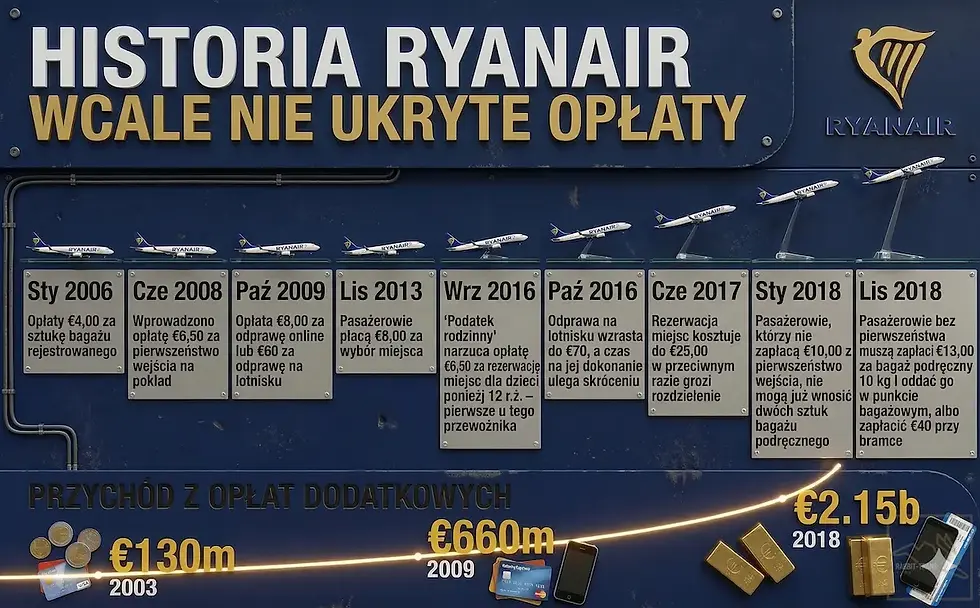
Expensive hidden costs: Hidden taxes and draconian penalty rates (Ancillary) for late check-in payments are driving an extra €4.7 billion in profits. At the same time, these same policies guarantee the airline the absolute bottom of all independent consumer ratings (e.g., those of the prestigious Which? magazine).
Pollution Achievements: In 2019, the carrier stunned the markets. As the first institution in the world not associated with dirty electricity production or coal burning, it entered the list of the 10 largest gigatonne CO2 emitters in the European Union.

Michael O'Leary Biography
If you plan to understand anything about the phenomenon of this iron money-making machine, it is crucial to understand the brazenly pragmatic nature of the person who holds the reins in his own hands.
The path to the very pinnacle of aviation power
Michael received a solid education at the esteemed Trinity College in Dublin. However, he began his career not on the runway, but as a highly promising tax expert and advisor at KPMG.
His genius lay in successfully shielding Tony Ryan's vast private assets (including numerous horse farms) from the clutches of the tax authorities. This powerful client trust guaranteed him the keys to the boardroom of the new airline.

Michael O'Leary's Famous Taxi
There is probably no funnier description of this turbo-capitalist swindler than the situation recorded by the press and politicians in early 2004.
Fed up with wasting time in irritating traffic jams between his home in Mullingar and the main office, he unsentimentally forked out £4,000.
With that money, he bought back the dusty license of a failing corporation and renamed it "O'Leary Cabs." He mounted a large yellow "rooster" on the roof of his own prestigious Mercedes S-Class and hired a personal driver.
Where absurd regulations enter into dialogue with ingenuity, a legal way to bypass traffic jams using empty city bus lanes emerges – and right in front of the faces of nervous state dignitaries.
Ryanair's Future: Plans and Strategies
No one in their right mind in Dublin plans to rest on their laurels. The coming years and decades will see plans for massive ecological cuts and millions bet on artificial intelligence draining our credit cards.
Service Innovation: Always Getting Better and the Brilliant Ryanair Labs
Consumer hatred almost reached critical mass around 2014. The "Always Getting Better" image program proved to be a lifeline.
The inhuman chaos during the sprint to the plane was finally eliminated by officially distributing numbered chairs and relaxing the baggage policy.
The undisputed technological breakthrough was the launch of Ryanair Labs' analytical division (created, among others, by Polish minds in Wrocław). The star of the show is the famous intelligent program known internally as "Brainer."
In every fraction of a second, it can change the price of your dream cabin bag or priority rail ticket based on dozens of variables from the local market, guaranteeing the company absurdly large increases in revenue.
Further expansion in the European market and the fight for sustainable development
The corporate goal for the end of fiscal year 2034 is simple and consists of complete takeover of the skies: 300 million passengers per year transported using a gigantic armada of 800 airframes.
Due to the painful image patches of the coal giant, the airline focuses on ecology, credible through cooperation with external fuel corporations (Eni in Italy, Neste in the Netherlands).
The iron deadline is 2030 – by then, aircraft with a harp on their tails must absolutely start burning a volume that guarantees at least 12.5% use of sustainable aviation fuel (SAF).
FAQ: Everything you need to know about Ryanair's history and business model
Quickly finding specific information about this carrier is crucial. Below, I've collected the most pressing questions and short, comprehensive answers about its history, fleet, and aggressive market strategy.
Who founded Ryanair and when? The company was founded in 1984 by Irish entrepreneur Tony Ryan and his sons, initially under the name "Danren Enterprises."
What was Ryanair's first flight like? It took place on July 8, 1985, from Waterford to London Gatwick using just a 15-seat turboprop aircraft.
Why did Ryanair's first flight attendants have to be so short? Due to the extreme cramped conditions of the first Embraer EMB 110 aircraft, cabin crew could only measure a maximum of 152 cm.
Has Ryanair always been a low-cost airline? No, in 1988, the carrier unusually offered luxurious business class and a frequent flyer program, which quickly resulted in multimillion-dollar losses.
Who is responsible for the company's current success? The chief architect of its power is Michael O'Leary, who, after taking over as CEO in 1994, implemented a radical cost-cutting model and eliminated free services.
What exactly is the airline's operating model? It relies on direct point-to-point flights, the use of cheaper secondary airports, and charging a premium for additional services.
Why does the carrier use almost exclusively one type of aircraft? Fleet unification drastically reduces crew training costs, minimizes spare parts storage, and allows for the rapid replacement of broken aircraft.
What aircraft are currently flying in the holding's fleet? The core of the fleet are the reliable Boeing 737-800 NG, which are steadily being replaced by the more fuel-efficient and spacious Boeing 737-8200 MAX ("Gamechanger").
What is Lauda Europe's role within the group? It's the only airline in the holding company flying competitive Airbus A320 aircraft, which serves as an excellent negotiating scare for the board during price negotiations with Boeing.
Who owns the Polish airline Buzz? Buzz is a subsidiary of the Ryanair holding company, serving charter flights, among other services. It was established in 2019 through a rebranding of the former Ryanair Sun.
Why were Ryanair UK and Malta Air formed? The former securely protects UK operations after Brexit, while the latter allows for legal tax optimization and facilitates the opening of routes to Africa.
What are the operating costs (CASK) of this carrier? They remain at an absolutely unrivaled level in Europe, 2.5-3.0 eurocents, leaving traditional competitors far behind.
How did Ryanair combat state aid during the COVID-19 pandemic? The holding company's lawyers successfully challenged and blocked multi-billion-dollar state aid payments to national airlines like Lufthansa and Air France in the EU General Court.
Why did the company remain union-free for so long? Management firmly and effectively blocked unionization for 30 years, relenting only after the massive disruption to the flight network and the looming threat of massive losses in the fall of 2017.
How does Ryanair's pricing algorithm for additional services work? Engineers have implemented the intelligent "Brainer" analytical system, which analyzes the market in fractions of a second and maximizes baggage and priority boarding rates.
Why did Michael O'Leary buy a taxi license in 2004? The airline's boss founded his own transport company solely to avoid traffic jams in his luxurious Mercedes, legally using city bus lanes.
What are the reasons for the company's image problems in the context of environmental protection? In 2019, Ryanair's aggressive growth led it to become the first non-energy company to be officially listed among the top 10 CO2 emitters in the European Union.
What is the airline's environmental goal for the coming years? To meet EU standards, the company plans to transition to using 12.5% sustainable aviation fuel (SAF) in its engines by 2030.
How many passengers does the holding company plan to serve in the future? Its long-term, official strategy aims to reach 300 million passengers transported annually by 2034.


Comments