
Taxi Drivers Rescuers on Polish Roads - Who is a road rescuer?

Ambulances aren't often the first to arrive at the scene of an accident and provide first aid—that's what people you pass by without a second thought. Doesn't a taxi driver sound like a paramedic? A mistake that could cost you more than you think.
In fact, they arrive at the scene of an accident faster than the system, taking the chaos and turning it into action. See who a roadside responder really is and why they're changing the rules of the game in urban safety.

Who is a Taxi Driver Road Rescuer?
A taxi driver road rescuer is a certified volunteer who, combining his daily paid work with a pro-social mission, has specialist medical knowledge and equipment to provide pre-hospital first aid.
Just think how difficult modern urbanization and constant traffic jams make it for heavy ambulances to get there. In my experience, professional drivers, spending dozens of hours a week behind the wheel, naturally evolve into mobile emergency response units .
Being in constant motion, on main arteries and on the outskirts of cities, they often arrive at the scene of an incident – an accident, a fire or a pedestrian suffering a sudden cardiac arrest – much faster than the systematically dispatched ambulance or fire brigade units.
As a result, the response time , which is crucial in emergency medicine and commonly known as the "golden hour" and "platinum ten minutes", is drastically shortened.
In reality, a direct witness, armed with rigorous operational algorithms, takes complete initiative on the tarmac. Where commercial transportation services go hand in hand with public safety, a completely new and fascinating role is born: that of a social guardian of life.
Growing popularity among taxi drivers
My observations suggest that over the past few years, there has been a significant increase in interest in rescue courses among professional drivers. What's the reason for this?
Increasingly congested and overloaded road infrastructure translates directly into a higher statistical risk of collisions and mass incidents .
Drivers, being habitual witnesses of these human tragedies, were simply fed up with the paralyzing psychological helplessness.
Implementing specialized training is an excellent tool for them to cope with stress – it transforms a passive observer into an active actor, regaining real control over their own professional environment.
Interestingly, taxi companies and modern application platforms quickly recognized this grassroots phenomenon as a brilliant method for building a decisive competitive advantage and a corporate social responsibility (CSR) strategy.
Offering a ride with a driver who knows how to save your life in the event of a shock is priceless for consumers, often outperforming the price per kilometer or the car brand itself.
Investing in advanced training becomes proof of the company's genuine concern for the health of its citizens, and for the drivers themselves – a gateway to higher prestige in the local urban environment.

The Role and Tasks of a Road Rescuer
The presence of a trained volunteer on the scene immediately brings order to the chaos and reduces the enormous risk of fatal errors during the most critical moments of the operation. This role goes far beyond the mechanical act of applying pressure to the sternum or tying a bandage.
In the pre-hospital setting, a certified taxi driver acts as a coolly calculating director of the crisis space.
Its primary task is a holistic analysis : mitigation of threats from oncoming vehicles, physical security of the area, structured call for services and psychological support for the injured.
Just look at this mechanism: while an ordinary driver succumbs to the diffusion of responsibility known as the "bystander effect" (tacitly assuming that someone else will call the ambulance), a trained paramedic takes strong, directive steps.
He effectively breaks down the paralyzing barrier of fear in crowds. Armed with knowledge and bright signage, he quickly becomes a natural leader in an unstructured environment, imposing a framework on the gawkers until the traffic lights arrive.
Competencies and Qualifications of a Road Rescuer
Obtaining this elite title is subject to precisely defined and very strictly enforced formal requirements. The most common institution awarding the title is the renowned Polish Automobile and Motorcycle Association (PZM) .
A candidate aspiring to such a title must be of legal age and must be a member of the appropriate local automobile club.
The knowledge assessment itself isn't just a casual chat over coffee. To even be admitted to the finals, a student must demonstrate 90% attendance in challenging theoretical and practical sessions. The exam is a two-stage, exhausting battle against stress.
The theoretical section concludes with a test requiring a minimum of 90% correct answers to pass. This demonstrates that the PZM (Polish Medical Association) tolerates absolutely no compromises in medical knowledge.
Passing the theory test opens the gate to drawing a practical scenario – where what counts is fluency, manual skills and cognitive speed of decision-making with an injured person in your arms.
Those with a higher level of Qualified First Aid (KPP) can optimize this process through a special refresher seminar. Crucially, rescuers must actively demonstrate their proficiency annually, which protects them from degrading the reflexes they learned on the mat.
Managing the Rescue Operation at the Accident Site
The basic and absolutely indisputable paradigm of every rescuer is to absolutely ensure one's own safety .
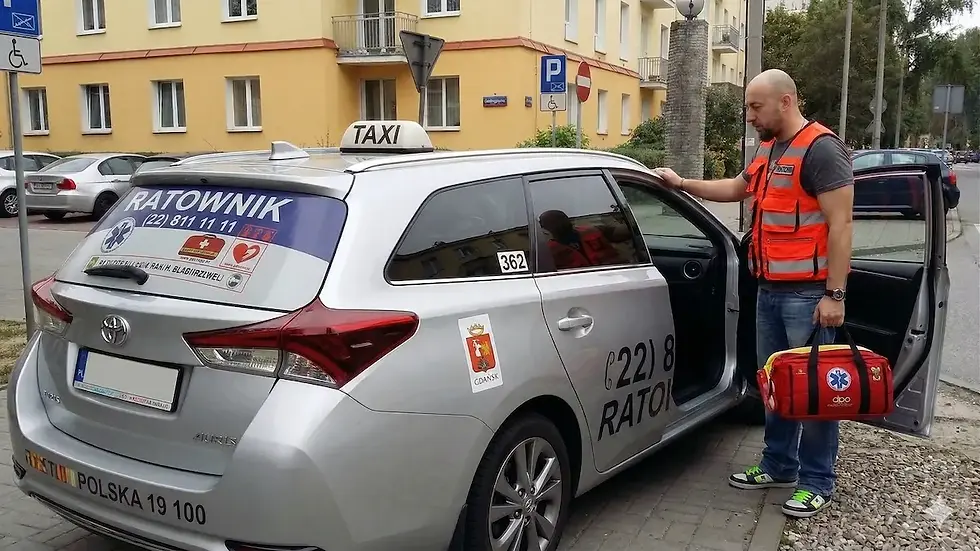
A stopping taxi driver must first arrange his car perfectly – usually in a protective "herringbone" pattern – turn on the appropriate lighting and place a warning triangle at the appropriate distance from the collision.
It's also essential to wear a bright reflective vest. Failure to follow these rules could result in a catastrophic secondary accident.
Managing the incident primarily involves assessing the kinematics of the damage and taking a look at the number of injured people.
A skilled operator must take the behavioral initiative here. Instead of throwing trite slogans at the hysterical crowd, they precisely delegate tasks .
He points to a specific person: "The man in the red glasses! Please call 112 and get back to me!" He tells someone else to run for the nearest defibrillator in the office building.
As a result, the channeled energy of onlookers ceases to be a threat, and the rescuer can lean over the injured person, looking for massive, spurting arterial hemorrhages or checking for breathing.
Advantages of a Road Rescuer who is a taxi driver
Where the craft of a professional transporter intertwines with medical procedures, an operational synergy is created that is difficult to compete with. A taxi driver's absolute greatest advantage at the scene of an accident is their perfect topographical orientation .
Bypassing unreliable GPS devices, these drivers memorize unmarked streets, fire exits, and "black spots." This allows them to direct the ambulance dispatcher in a split second, cutting off precious minutes spent wandering around the heavy ambulance.
Another ace up their sleeve is the company's powerful radio communications . With a single click of the panic button, a taxi driver can summon a dozen or so corporate colleagues to the scene of a tragedy in a matter of moments.
The fleet of vehicles becomes a barrier shield for gawkers, physically blocks intersections before the LPR helicopter lands, and delivers additional medical tourniquets.
Importantly, the daily grind of working with demanding or drunk clients hones these individuals' above-average negotiation skills . The ability to control a furious man in the backseat translates brilliantly to calming the victim's shaken mother in a ditch.
Road Rescuer Training
Efficiency, confidence, and repeatability in crisis situations are the result of exclusive and rigorous evidence- based training (EBM). The process of educating candidates in taxis is a deliberate behavioral engineering, eliminating tunnel vision in favor of pure, mechanical algorithms on the tarmac.
What does the training program and accident simulations look like?
The framework program created by the PZM (Main Commission for Road Safety) is most often implemented during exhausting weekend sessions lasting only a dozen or so hours.
Of this, only a modest two hours are devoted to essential legal theory, which is intended to remove the fear of intervention and liability from students. The Association instills a simple principle: the only mistake is doing nothing .
However, the real development of skills takes place on the maneuvering yard. Experienced instructors from PZM or rescue companies force drivers to physically confront cutting metal .
This includes training in pulling passengers from smoke-filled wrecks, freeing passengers from trapped cabins, and even breaking hard car windows safely.
Such immersion, enriched with make-up and fake blood, irreversibly desensitizes the taxi driver's psyche to the sight of cracked skin.
Main PZM training modules – what will you learn?
This program is concise, extremely logical, and structured in a step-by-step fashion. The most important teaching pillars include, without compromise:
Legal basis: Rights and obligations of the rescue operator and his protection when saving lives in a state of emergency.
Early action strategy: Principles for creating safe zones, ergonomic use of warning tools and optimal communication with emergency numbers.
Anatomy and trauma: Rapid analysis of respiratory patency, identification of hidden symptoms of hemorrhagic shock and methods of preventing hypoxia.
Aggressive field techniques: Clean evacuation procedures (like using the classic Rautek hold) and closing extreme massive bleeding from lower and upper limbs.
Cardiopulmonary resuscitation and AED use
The medical cornerstone of reversing cell death on the street is cardiopulmonary resuscitation (CPR) . Irreversible damage to the oxygen-deprived human brain begins as early as 4-5 minutes.
This means that passively waiting for the state team to arrive is tantamount to issuing a judgment.
That's why taxi drivers sweat profusely in airway management and the "see, hear, feel" technique. If breathing isn't present, compressions are performed to a depth of 5-6 cm at a rate of 100 to 120 compressions per minute (at a classic 30:2 ratio).
Modern technology is a wonderful complement to this physical strength. Effective courses are based on the philosophy of early defibrillation using an automated external defibrillator (AED).
Using this little trunk-mounted "life generator" within the first few minutes increases the target chance of the patient leaving the hospital on their own to a staggering 75%.
Road Rescue Organizations and Courses
Understanding the power of taxi rescue drivers would be incomplete without appreciating the infrastructure that unites these passionate individuals. These cohesive club networks create a breeding ground for precise rescue talent on roads across the country.
The role of the Polish Automobile and Motorcycle Association and the Moto-Auto-Club
The Polish Automobile and Motorcycle Association remains the undisputed leader in shaping pre-hospital road rescue.
Using the rigorous and constantly updated recommendations of the European Resuscitation Council (ERC) , the association ensures that drivers rely on science, not the myths of grandmother's poultices.
The burden of practical education most often rests with smaller regional centers – such as the Moto-Auto-Klub or the RES Association.
Regular weekend recruitment events organised by these entities prove that the bloodstream of fresh personnel willing to civicly defend the weaker never dries up in Poland.
Activities of the Polish and Greater Poland Automobile Club
The approach of the Automobile Club of Wielkopolska deserves particular recognition. This institution operates in a remarkably holistic manner.
In addition to issuing IDs, it puts its rescuers on the front lines of preventive activities – they insure rallies, teach children in kindergartens the basics of bandaging and organize mass events.
Since 2001, pursuant to important decisions by the Polish Motorsport Association (PZM), the Poznań Personnel Training Center has also been operating. Instructors use the renowned Poznań Circuit to rigorously demonstrate the power of physics. They teach young drivers the optimal position behind the wheel and tire behavior on slippery roads.
Prevention and education about the consequences of speeding are worth exactly as much there as the skill of tightening a tourniquet.
First Aid in Road Accidents
Rescue after severe head-on collisions in the city is a harsh discipline, combining trauma care with downright callous engineering pragmatics.
In the courses, academic theorizing is deliberately discarded in favor of brutally effective tactical guidelines, which the rescuer executes in a cloud of shock and blaring horns.
Basics of roadside first aid
The basic approach to managing a patient in the field is based on the universal ABCDE algorithm . After donning nitrile gloves (a basic protective barrier!), the rescuer must establish their level of consciousness by vigorously shaking their shoulders and loudly asking, "Are you okay?"
However, in the standard practice of severe highway trauma, priorities are slightly adjusted before even checking for breathing. The absolute priority in the PHTLS protocol becomes locating and then aggressively and immediately clamping down on massive external hemorrhages .
Rapid bleeding from the femoral arteries is by far the most common cause of sudden death requiring reversal in collision victims.
Moreover, the specific nature of work behind the wheel requires taxi drivers to recognize acute medical incidents among passengers: from fainting in the seat to unexpected epileptic seizures or strokes in an elderly passenger.
How does medical triage TRIAGE work?
The real baptism of fire of the operator's cognitive abilities comes at the moment of a multi-body collision, where there are many more injured in bus crashes than there are hands available to help.
This is where the cold, merciless statistics of utilitarian ethics come in: START (Simple Triage And Rapid Treatment) tactical triage . This brutal approach mandates that each casualty be assessed in 30–60 seconds at most and assigned to the appropriate priority group based on breathing, heart rate, and consciousness.
The color system is the only support on the ruins:
Green: Mildly injured individuals. Walking independently after being instructed to do so. This is a group in shock, waiting on the side of the area for the final phase of medical care.
Red: Critically ill patients with breathing rates greater than 30 or less than 10 per minute, or with a visible absence of a radial pulse and a prolonged capillary refill time. They require an ambulance with sirens on immediately.
Yellow: Traumatic victims lying down and unable to exit the wreckage, but stable. They are following commands and breathing regularly, patiently awaiting transport under the supervision of paramedics.
Czarny: Unfortunately, this is a catastrophic category. Patients with complete respiratory arrest, whose breathing doesn't return despite physical airway management. Given the shortage of human resources, this means forgoing strenuous CPR in favor of those screaming and promising in the operating room.
During the training, psychologists drill taxi drivers into the problem of fatal underestimation of wounds (under-triage), which condemns patients bleeding internally in silence to death, as well as blocking ambulances and over-triaging the trauma .
Road Rescue Equipment and Equipment
Excellent technical training and muscle memory are only half the puzzle in the dark on the highway.
A taxi of a certified PZM operator must contain rigorously certified rescue equipment in the trunk and on the back seat to realistically cope with deep cuts in sheet metal and glass.
What's in a car first aid kit and why is a vest crucial?
A legitimate taxi driver rescuer has a conspicuous, certified safety vest with a visible back stating "Road Rescuer".
This is a key psychological element – it builds an aura of cold professionalism and unquestionable authority, separating the rescuer physically working with the injured person from the uncontrolled crowd of hysterical onlookers.
The medical heart of operations in dirty conditions is a medically outstanding first aid kit assembled exclusively according to the strong, cutting-edge German industrial standard DIN 13164. This standard throws into the trash cans those destructive, supermarket-branded boxes with negligible contents.
The durable suitcase, resistant to frost and impacts in the trunk, holds dozens of radiation-sterilized, powerful dressings, sterile compresses and specialized non-woven bandages for broken arms.
This wealth is complemented by blunt, upward-curved rescue scissors (allowing for absolutely emergency, ruthless cutting of the shirt or jeans of a trapped person without cutting his navel) and the obligatory NRC isothermal foil with metallic colors.
Its rapid application to the wounded prevents the lethal, clotting-killing effects of shock hypothermia on bodies lying on the asphalt in winter.
Significantly, the guidelines strictly prohibit putting your own painkillers into such bags – sudden temperature changes in cars destroy the medications and can cause anaphylactic shock.
BRAYDEN phantoms, i.e. innovations in resuscitation science
Speaking about the technology implemented by PZM paramedic taxi drivers, one must appreciate how hard they learn to perform this hard heart massage in the wards.
Outdated "inflatable" dummies are being thrown out. Modern educational centers boast a full range of intelligent medical trainers , including the groundbreaking Brayden PRO manikins.
Electronics placed just beneath the phantom's skin analyze the rate of 100 to 120 compressions with precisely responding LED lights. These show the trainee the clearly anticipated stream of oxygen being squeezed from the heart directly into the patient's neck vessels.
The full-circulation light rewarding the rescuer is activated only in that short fraction of a second of perfect, even Olympic precision, pressing the sternum.
Training also includes rigorously reviewed baby dummies used to teach how to remove foreign bodies from choking children. These dummies help the adult professional's hardened mind develop reflexes that brook no delay.
Volunteering in Road Rescue
Successively transporting the injured with a certificate in your own car is a higher, honorable level of honorary public volunteering.
This activity, however, is burdened with enormous psychological pressure that has been building for weeks. The grimy reality of the streets is a confrontation with premature death, incredible human suffering, and a terrifying chaos intensified by the smell of gasoline.
Crowd Psychology and Crisis Management at the Scene of an Incident
Participants in road accidents experience a powerful nervous shock, which often evolves without mercy into devastating Post-Traumatic Stress Disorder (PTSD) .
For this reason, a properly trained taxi driver implements the calm elements of psychological first aid on the street. An authoritative, measured voice, free from shouts of hysteria, is the foundation for containing the fear that ripples around.
The determined gaze cast upon the bleeding driver as he is dragged from his seat prevents him from uncontrollably witnessing the horror of his injuries, calming the shockwaves of adrenaline and stress-inducing cortisol that weaken his body.
Instructors tirelessly prohibit the use of manipulative and empty phrases: "Don't worry, everything will heal soon, there's nothing wrong with you."
This type of falsehood is immediately exposed by the conscious and terrified pain of the injured person's brain. Instead, the rescuer learns to offer rational certainty on a platter: "Stay with me, the ambulance is definitely on its way. Now help me press on this wound with your fingers."
It is interesting to see what adult volunteers can do with their own post-accident burden after a terrible incident involving bodies on metal sheets.
Research clearly suggests playing a few games of regular and spatial Tetris within a few hours of a bloody visual trauma. This cognitive puzzle effectively reduces recurring, debilitating flashbacks!
How does volunteering impact local safety?
Obtaining a special Road Rescuer Booklet doesn't mean you have to lock yourself in a taxi at night, listening for accident reports. These people with the PZM logo are brilliant and very reliable community safety activists .
They are determined to protect major outdoor sporting events, cover city running routes, and assist in difficult and long coach trips for primary school children.
Through an authentic, direct example of tangible concern for suffering, they break the myth of the stereotypical taxi driver.
They clearly prove to the entire world stimulated by digitalization and to passers-by constantly staring at their phone screens that deeply hidden human empathy, burdened with courage and strong, rescue craft, has a gigantic raison d'être in every hour of the big city bustle.
This builds up a huge, soothing capital of faith in the rear passengers that their calm master with the price list on is, in the event of a major emergency, a ruthless street defender of their fragile lives.
In which companies can you find rescue taxi drivers?
Increasingly, the presence of certified paramedics in the fleet is becoming standard in Polish cities. Taxi drivers with medical certifications and appropriate equipment can now be found in both large national networks and local carriers.
Just look at these examples:
iTaxi: A nationwide network. The company has organized advanced Qualified First Aid (QF) courses for its drivers in collaboration with, among others, the Rescue Center. You can encounter taxi drivers and rescuers under this brand on the streets of Warsaw, Krakow, Katowice, and the Tricity area.
City Taxi Gdańsk: A recognizable brand in the Tricity market. Its drivers undergo regular training under the supervision of instructors from the local Automobile Club, ensuring they are prepared to respond to emergencies in city traffic.
Hanza Taxi, Hallo TAXI Gdańsk and CTaxi: Other corporations from Pomerania, whose structures also include care for the rescue competences of drivers.
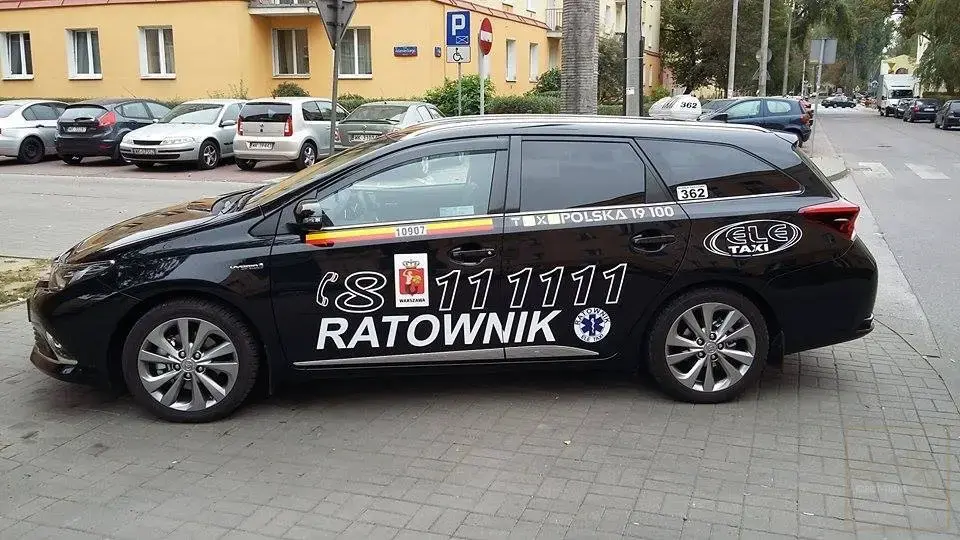
ELE TAXI: A Warsaw-based network whose medically trained drivers not only operate daily routes in the capital, but also often provide preventive security at mass events and children's trips.
Thanks to such initiatives, commercial passenger transportation is gaining a completely new value. As a result, when you order a taxi, you have a greater chance of having someone behind the wheel equipped with an AED and specific knowledge, ready to provide expert assistance on the road before the ambulance arrives.
FAQ – Taxi Drivers, Rescuers and First Aid on the Road
Learn the most important information about the role of roadside rescuers in taxi companies. The following summary briefly explains the procedures, powers, and specifics of their actions at the scene of an accident.
Who is a taxi driver road rescuer? : This is a certified volunteer driver who, thanks to specialized training and medical equipment, provides qualified first aid before the arrival of emergency services.
Why do taxi drivers become rescuers? : They spend dozens of hours behind the wheel, know the city's topography perfectly, and have a company radio network at their disposal, which drastically shortens the time it takes to reach the injured.
What training does a roadside paramedic need to undergo? : They must complete a rigorous course that includes legal theory, practical anatomy, and brutally realistic traffic accident simulations.
Who awards the Road Rescuer title? : This title is most often awarded by the Polish Automobile and Motorcycle Association (PZM) or an authorized local Automobile Club after passing a two-stage, difficult exam.
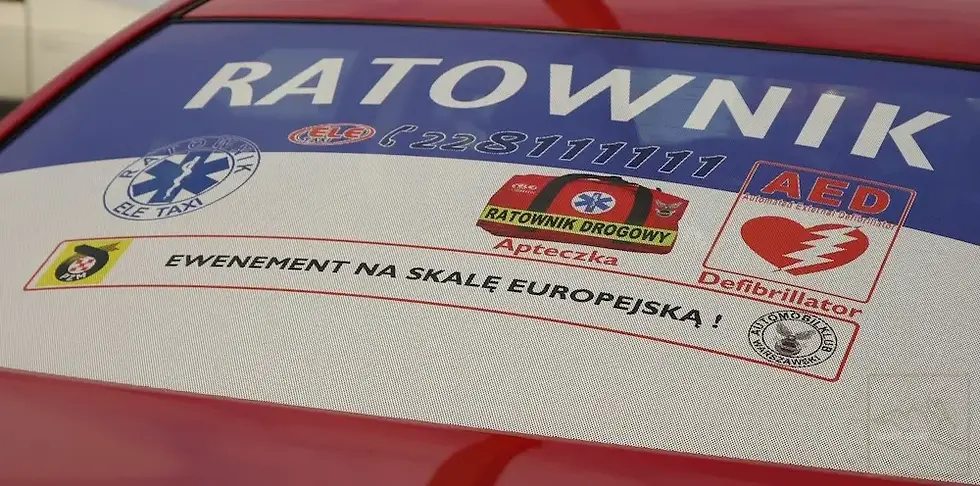
How to recognize a road rescue taxi? : Such a vehicle has an official PZM certification sticker, and the driver intervenes in a bright reflective vest with the inscription "Road Rescuer".
What is the first thing a rescuer does at the scene of a collision? : They always start by ensuring their own safety and the safety of the scene by placing the car in a herringbone position, turning on the lights and setting up the warning triangle.
What medical equipment is a rescue taxi equipped with? : The basic equipment is a professional first aid kit compliant with the strict DIN 13164 standard, isothermal foil (NRC), rescue scissors, and often also an automatic external defibrillator (AED).
Can a roadside rescuer give painkillers to an injured person? : No, the guidelines strictly prohibit carrying and giving medications due to the risk of anaphylactic shock and the decomposition of chemicals in a hot car.
What is the START medical triage system? : It is a tactical method for rapid assessment of casualties in mass casualty incidents that divides casualties into transport priorities using the colors red, yellow, green, and black.
Does the rescuer immediately pull the injured out of the wrecked car? : Evacuation from the wreck is only carried out in the event of an immediate threat (e.g. engine fire) or the need to immediately start resuscitation (CPR).
Which corporations employ qualified road rescuers? : Certified volunteers can be found in the fleets of iTaxi, City Taxi Gdańsk, Hanza Taxi, Hallo TAXI, CTaxi and Warsaw's ELE TAXI, among others.
Does a driver who has completed the KPP course automatically become a Road Rescuer? : No, people with the state title of Rescuer (KPP) must complete an additional PZM supplementary seminar to take into account the specificity of purely road rescue.
How does a taxi driver deal with panic and gawkers on the street? : He takes the behavioral initiative by issuing short, directive commands (e.g., pointing to a specific person to call an ambulance), which breaks up the chaos and the "bystander effect."
What psychological support does the rescuer provide to the injured person? : He maintains firm eye contact, isolates the person from the sight of the destruction and provides truthful information, categorically avoiding false promises such as "nothing will happen to you".
Is the title of Road Rescuer awarded once and for all? : These authorizations require continuous activity; the rescuer must annually confirm membership in the PZM and participate in rescue or improvement events.


Comments