
How to check the side number of a taxi in Poland and Europe?

Standing in front of a taxi and want to check if it's really the car you're supposed to be driving? Don't just look at the company logo or the sticker on the door.
Read the side number, write down the license plate number, and check the details in the city's taxi database, if available. In Gdańsk and Wrocław, you can do this online. In other cities, you'll need to contact the licensing office for information.
The mere presence of a number on a vehicle does not constitute confirmation of current entitlement. The most telling aspect is the comparison of the vehicle's designation with official data.

How to check the side number in practice? 5 steps
There's no need to investigate in the parking lot. In most situations, you just need to pay attention to a few things—ideally before you start your ride.
Find the taxi's license plate. Start with the front door and side markings. Look for the number next to the city's name or coat of arms. There's no single design that applies across Poland, so a taxi from Gdańsk may look different than a licensed car in Warsaw or Poznań.
Write down the side number, license plate, and city. This is more important than it might seem. Note the entire side number—including the dash, if present—as well as the vehicle's license plate. It's also a good idea to write down the city shown on the plate. A company phone number is a different story.
Check the official database if your city provides it. Below you'll find examples for Gdańsk, Wrocław, Warsaw, and Poznań. If the search engine allows you to search for multiple entries and the side number doesn't yield a result, try the license plate number.
Compare the result with the car in front of you. The mere fact that a number plate exists in the database doesn't mean much if the data refers to a different car. If you booked your ride through the app, also check the registration, car model, and driver information displayed in the order.
Clarify any discrepancies before the trip, not after. If the driver's number, registration, or details don't match, ask the driver or contact the carrier. If the explanation doesn't convince you, it's safest to choose another vehicle.
This is especially useful at the airport, at the train station, or late in the evening when several similar cars arrive and it's easy to get into the wrong car.
There's another reason to write down this information. If you later discover you left a phone, backpack, or suitcase in the taxi, the license plate number and registration can make locating a specific ride much easier.
What does a taxi side number actually mean and how is it different from a license?
It's easy to lump several different numbers into one basket. The car has license plates, it may have a side number, the entrepreneur operates under a license, the driver may have their own ID, and then there's the route number in the app.
These are not interchangeable designations.
The side number is found on the taxi's local number plate. It's used to identify the taxi within the system used in a given city.
The registration number is found on the vehicle plates and identifies the car.
The license number refers to the authorization of the entrepreneur carrying out passenger transport by taxi.
The taxi driver ID refers to the person behind the wheel, as required by the city.
A good example is Warsaw. There, the side number consists of the license number and the extract number, separated by a hyphen.
The city service uses the format 00000–0000. So if you're writing down such a number for later verification or reporting, copy both parts.
And one more thing: write down the number along with the city . The side number isn't a single nationwide identifier that can be used to check every taxi in Poland.
Similarly, the order number in the app indicates a specific trip, not the vehicle's city code. If you later file a complaint or try to locate the vehicle, it's a good idea to include both.

Where to find taxis in Poland? Gdańsk, Wrocław, Warsaw, and Poznań
The most important rule is simple: check the car in the system appropriate to its designation .
Just because a taxi drives in Gdańsk doesn't automatically mean it's licensed by Gdańsk. In the Tricity area, this is especially important, as the vehicles travel between Gdańsk, Gdynia, and Sopot.
Not every municipality provides passengers with the same register.
City | Where to check? | What to pay attention to? |
Gdansk | You can search by side or registration number. Compare vehicle data and check the update date indicated in the database. | |
Wroclaw | The search engine accepts the taxi's side number or license plate number. The city states that the database is updated weekly. | |
Warsaw | Compare the side number, coat of arms, and yellow-and-red stripe. To verify eligibility, ask the office to identify the appropriate unit. | |
Poznań | You'll find the number on the front doors and rear of the body. The QR code on the price list applies to the vehicle; the code on the driver's ID allows you to check information about their authorizations. |
Wrocław: QR code helps, but it doesn't guarantee anything
In Wrocław you can find a "Check taxi" sticker with a QR code leading to the city's database.
This is convenient because instead of manually entering the website address, you scan the code and go to the vehicle details. However, it's worth exercising common caution here: check the actual website the code leads to .
The city warned against stickers with invalid codes that didn't come from the city. Therefore, the QR code itself doesn't constitute proof of a legitimate ride. It's just a way to access information.
Gdańsk: look at the city sign, not just the company logo
In Gdańsk, the official marking combines a coat of arms, a side number, and the inscription "GDAŃSK." The design stems from a resolution regarding additional taxi markings.
For a passenger traveling in the Tricity area, this is an important detail. The company logo tells you what kind of carrier you're dealing with, but when checking a license, you're primarily interested in the taxi's identification and the office responsible for its licensing .
And here comes another trap: a foreign coat of arms does not automatically mean an illegal course.
The Act permits travel outside the licensed area, as well as certain return journeys and customer orders from another area. This is provided for in Article 6, paragraphs 4-5 of the Road Transport Act.
Therefore, the Gdańsk search engine shouldn't be considered a registry of all taxis currently located in Gdańsk. A car may be based in Gdynia or Sopot and operate in accordance with regulations.
Therefore, when verifying, be guided by the license marking, not just by the letters on the license plate or the place where you happen to see the car.
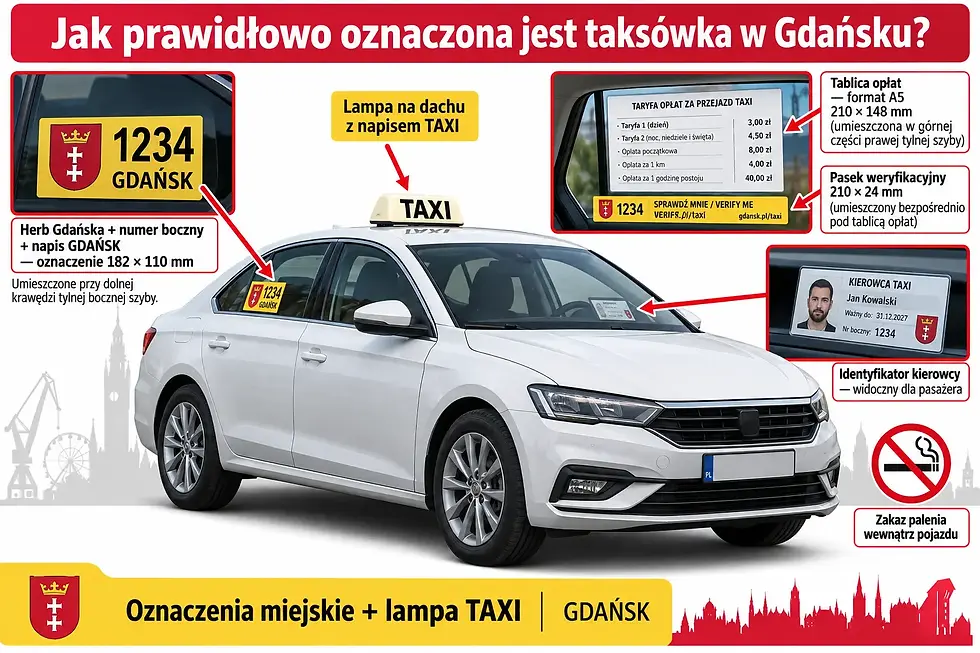
TAXI lamp, ID badge, price list – what else to check?
The side number is important, but it shouldn't be the only thing you look at.
National regulations stipulate that a lamp with the word TAXI must be placed on the roof of a taxi .
Additional elements—side number, coat of arms, stripes, or other markings—depend on local regulations. The basis for the TAXI marking can be found in Section 24 of the Regulation on Technical Conditions for Vehicles.
Warsaw has its own, rather distinctive system. Requirements include a yellow-and-red stripe, a coat of arms, a side number, pricing information, and a driver ID visible to passengers.
This doesn't mean, however, that every Polish taxi must look the same. A taxi driver from another city doesn't have to display a Warsaw stripe or the Warsaw coat of arms. Always check the vehicle's licensing regulations.
What if there is no traditional taximeter in the car?
The mere lack of a classic taximeter does not mean that the transport is illegal.
If used, an electronic taximeter must have a valid certificate of legalization. However, payments can also be made via a mobile app that meets the relevant regulations.
Therefore, before a ride, the more practical question is not: " Where is the taximeter ?", but: "How will the price be calculated?"
If you're booking a ride through an app, check the price and the pricing rules. For a traditional taxi, pay attention to the price list, tariff, and any additional fees. If anything is unclear, the driver should explain the pricing rules before the ride.
If you have a previously planned transfer in Tricity, you can also check the Rabbit-Trans Poland price list and travel calculator.
How to check a taxi in other European countries?
Abroad, the Polish reflex of looking for the "side number on the door" quickly ceases to be enough.
In some countries you will find the number on the rear window, in others on a separate license plate, and in still others the most important thing will be the car registration and driver card.
There's also a distinction between a classic taxi and a chauffeur-driven car, which must be booked in advance. This distinction is important in London, France, and Germany, among other places.
Therefore, instead of looking abroad for the exact equivalent of the Polish side number, it is better to ask yourself two questions:
What type of service have I ordered and what designation identifies it here?
The examples below show how much the answer can vary between countries and cities.
Germany: You will find the Ordnungsnummer on the rear window
In Germany, look for the Ordnungsnummer , or official identification number, in a taxi. It's located in the lower right corner of the rear window.
The sign should be legible both from the outside and inside. The name and registered office of the operator should also be displayed in the cab. The location of the sign is specified in § 27 BOKraft, and the taxi sign design features black numbers on a yellow background.
If you want to save your trip data, don't just save the Ordnungsnumber. Also, save the registration number, city, and company details visible in the cab. This will be much more useful when explaining the trip later.
There's also a second category: Mietwagen mit Fahrer , or rental cars with a driver. In Berlin, such vehicles have white license plates on a blue background, also displayed on the rear window.
This is a good example of why you shouldn't judge every car by the appearance of a classic taxi badge.
Czech Republic: you can check the car and driver without logging in
In the Czech Republic, the state-owned Portal dopravy — Ověření taxi operates.
You can enter:
RZ , i.e. car registration number,
or číslo průkazu řidiče taxislužby , i.e. the taxi driver's license number.
This service allows you to anonymously check a vehicle's registration or the validity of a driver's document. This isn't just a regular driving license.
The database is updated once a day, so official changes may appear in the system the following day. If something is incorrect, the portal indicates the office that entered the vehicle or issued the document.
Another important detail for those traveling to Prague is that Czech regulations also apply to taxis without a traditional taximeter, which provide specific, pre-booked services. The requirement for a registration sticker also applies to such vehicles.
UK: In London, first determine whether you are going by black cab or private hire
In London, these two services only look similar from the perspective of a passenger wanting to get from point A to B. Formally, they are two different systems.
For black cabs, check the white plate on the rear of the vehicle. It lists the vehicle's license number, expiration date, registration number, and maximum passenger capacity.
The driver has a separate identifier — badge .
And by the way: the name "black cab" doesn't necessarily mean the car has to be black. So color alone isn't a reliable way to verify.
Private hire , including minicabs, works differently. A vehicle must be booked in advance from a licensed operator. Compare the registration, driver's name, and license number with your booking confirmation. Look for license markings on the windshield and rear windows.
The vehicle and driver have separate authorizations.
Transport for London also offers a license checker that allows you to check drivers, vehicles, and private hire operators. However, this isn't a single database for all taxis across the UK . Outside of London, you'll need to find the appropriate authority for your area.
Ireland: Driver Check connects drivers with specific cars
There is an official TFI Driver Check app in the Republic of Ireland .
It allows you to check the vehicle registration number, driver's authorization and driver's photo.
Searches can be performed by:
car registration,
vehicle license number,
driver's license number.
The practical advantage of this solution is the ability to check not only two separate numbers, but also to link the driver to a specific car.
So, compare the photo with the person who actually drove up. Incorrect data can be reported through the app.
If you don't want to install anything, TFI also provides an online license registry.
Geography note: This guide applies to the Republic of Ireland. It should not be automatically transferred to Northern Ireland, which operates under a different legal system.
France: Taxi and VTC are not the same
In France, first determine whether you are looking at a classic taxi or a VTC , i.e. a car with a driver booked in advance.
In taxis, look for an exterior plate with the driver's license number and professional driver's card near the windshield. Taxis also have a light and a taximeter.
VTC has other markings: a red registration sticker and a driver's professional card with a photo.
Therefore, looking for the Polish side number on the door doesn't make much sense. Write down the registration number and license number from the marking appropriate for your type of transport.
In Paris, a driver report can be submitted using a Préfecture de Police form. For taxis, the form indicates the parking permit number, or autorisation de stationnement (ADS) .
One more thing is important about VTC: such a ride requires advance reservation. Simply offering a ride to a passenger at the airport terminal does not replace a reservation.
Spain: in Madrid, look for a municipal license
Spain is another example of a country where you shouldn't assume that all cities label taxis identically.
In the Madrid region, look for the municipal license number on external signs, including the front doors, and on a plate in the cabin.
The license number is different from the matrícula , or registration number. The marking also indicates the municipality issuing the license.
After your ride, it's a good idea to ask for a recibo , or receipt. According to official information from the Comunidad de Madrid, it should include information such as your license number, registration, tax ID, price, and date.
This can prove much more useful than trying to remember what logo was on the car an hour later.
For complaints, you can request a reclamation form . This is a document used to report a service issue, not a tool for checking license validity.
Netherlands: blue plate indicates a car, chauffeurskaart - a driver
In the Netherlands , commonly known as Holland, one of the primary distinguishing features of a registered taxi is its blue license plate . The driver, on the other hand, has a chauffeur's license plate with a photo.
These are two different elements: the plate identifies the car, and the card identifies the person behind the wheel. Company details are also included on the tariff card.
After your ride, keep your ritbon , a paper or digital receipt. It contains information about the ride, the company, and how to file a complaint.
If something happened during the trip, such a document will be a much better starting point than just remembering the company logo.
The taxi isn't in the database, or the details don't match. What then?
It is important not to draw too quick conclusions here.
A missing result could indicate a problem, but it could also be due to a typo, entering the wrong city, or a delay in updating the registry. On the other hand, simply finding the number in the database doesn't complete the verification process.
It's best to check three things separately:
car ↔ entry in the database, driver ↔ his ID, substituted car ↔ your order.
What do you see? | What to check next? |
No result in the database | Check the full number, typos, correct city, and database update date. Also try the registration number. If the problem persists, contact the appropriate office. |
The side number exists, but the registration is different | The number itself doesn't confirm the car in front of you. Ask for clarification and verify the details with the carrier or government office before starting your journey. |
The car is correct, but the driver looks different than in the photo | Check its ID and report the discrepancy to the ordering team. The vehicle's authorization does not replace the driver's authorization. |
The QR code doesn't work or leads to another page. | Visit the city's official website yourself. The sticker is for information purposes only—it does not, in itself, confirm a valid license. |
Also, do not try to replace the taxi register with a car history report.
The Government Vehicle History includes, among other things, information on technical inspections and third-party liability insurance, but this data does not automatically indicate that the entrepreneur has the appropriate license to transport passengers by taxi.
It also works the other way around: entering a car in the taxi database does not guarantee that the driver will calculate the price correctly or that no problems will arise during the trip.
You verify your eligibility. You do not receive a guarantee of the overall quality of service.

How do I find a taxi after a ride or report a problem?
A passenger often becomes interested in the side number only after the car has already driven away. The phone was left on the seat. The suitcase was left in the trunk. A question arose about the price. And then it turns out that a photo of the license plate or a written-down car number would have been very useful.
If you booked a ride through an app or a company, start with your ride history. Provide the date, time, route, and your license plate number, if you saved it.
When taking a ride from a rest stop, a receipt or other confirmation containing the carrier's details will be very helpful. The transaction itself, visible in the bank, doesn't always allow you to identify a specific vehicle.
If the problem concerns authorizations , please direct your inquiry to the licensing authority.
When it comes to pricing or service , start with the carrier or order processing. Instead of a general "the trip wasn't right," write down the facts: what happened, when, on what route, and what resolution you expect.
When abroad, also use the local documents described earlier – for example, the Spanish recibo or the Dutch ritbon .
A note you can keep after a problematic ride
City and country: …
Course date and time: …
Vehicle side number/license number: …
Registration number: …
Carrier/application and order number: …
Route and amount paid: …
Description of the incident or item left behind: …
Confirmations available: receipt / confirmation from the application / photo of the marking.
If you are reporting a lost item, keep one detail to yourself that will allow you to later confirm that the item really belongs to you – for example, information about the contents of a bag.
However, do not post a photo of the receipt online, along with the full route and personal information. Provide such materials directly to the carrier, platform, or office investigating the matter.
The most important sources
When preparing the guide, we used primarily official city websites, state registers and applicable regulations.
Poland:
Europe:
Local sources and regulations may be updated. If you're checking a specific vehicle before traveling or preparing a report, please refer directly to the relevant authority's current website.
Frequently asked questions about taxi number and taxi check
Where is the taxi side number?
It depends on the city and local signage regulations. In Poland, the side number is most often found on the exterior markings of the car, especially near the front doors. It may be located next to the coat of arms, the city name, or other taxi markings.
However, it's not worth memorizing a single design and assuming that every taxi in Poland will look the same. Local markings may vary.
Is the taxi side number the license number?
Not always. The side number is used to identify the taxi in the local system, but its construction depends on the rules in a given city.
A good example is Warsaw, where the side number consists of the license number and the extract number, separated by a dash. Therefore, you shouldn't automatically interpret every number visible on the door as a license number.
Is the side number the same as the registration number?
No. These are two different designations.
The license plate number is found on the car's license plate and identifies the vehicle. The side number is part of the local taxi marking system. When checking a car, it's best to write down both numbers, as together they provide much more information than either one alone.
Is there a single nationwide database of taxi side numbers?
The side number should not be treated as a single, nationwide identifier. Designation systems and data sharing methods vary by city and office.
Some towns have convenient online search engines, while others require verification at the licensing office. Therefore, it's a good idea to write down the license plate number along with the city marked on the car.
Can a taxi be checked by its registration number?
In some city databases, yes. For example, search engines in Gdańsk and Wrocław also allow verification by registration number.
This is especially useful if the license plate number has been misread or the search engine doesn't return a result. However, always use the database appropriate for the city or office responsible for the license.
What to do if the side number is not in the database?
First, don't automatically assume the car is operating illegally. Check that the number has been entered correctly, that you've selected the correct city, and when the database was last updated.
If your search engine allows, also try the registration number. If the discrepancy persists, the appropriate place for further verification is the licensing authority.
What if the side number is in the database but the registration number does not match?
This is a significant discrepancy. Finding only the side number in the registration doesn't confirm that the entry applies to the car in front of you.
Before starting your ride, ask for clarification and compare other vehicle details. If you booked your ride through an app or a carrier, also contact their staff.
What if the car is correct, but the driver looks different than in the app or on the ID?
A car's license and a driver's license are two different things. Just because a car is registered doesn't mean it's necessary to determine who should use it for a given course.
If you see different driver details in the app or the photo does not match the person behind the wheel, please clarify the discrepancy before starting your ride.
Does the QR code on a taxi confirm that the car is legal?
No. The QR code is primarily a way to quickly access information.
After scanning it, check the actual website and whether it's an official website. The mere presence of a code on the sticker doesn't confirm the license is current or the vehicle's details match.
Do I need to check a taxi ordered through Uber, Bolt or another app?
It's worth at least comparing the basic details. Check the license plate number, vehicle, and driver against the information provided in the order.
If another vehicle approaches or the driver offers a ride in a car you don't see in the app, it's best to clarify the situation with the platform before starting the ride. The mere presence of an Uber, Bolt, or other app logo on the vehicle doesn't guarantee data integrity.
Is it illegal to take a taxi with a sign from another city?
You can't draw such a conclusion just based on the coat of arms or the name of the city on the car.
The regulations allow for certain situations where a taxi travels outside its licensed area, as well as certain return journeys and customer requests from another area. This is particularly important, for example, in the Tricity area, where taxis operate between Gdańsk, Gdynia, and Sopot.
Therefore, a foreign designation is not in itself evidence of illegal operation.
Do the letters on the license plate tell you in which city the taxi is licensed?
The taxi's status should not be determined based on this. When verifying, it's better to rely on the vehicle's license plate and information about the relevant authority.
The place of registration of the vehicle and the area covered by the taxi license are not the same.
Does every taxi in Poland have to look the same?
No. Some requirements stem from national regulations, but additional markings are established locally.
Therefore, Warsaw's yellow-and-red lane or the specific markings in Gdańsk are not a model for every taxi in Poland. A taxi should be compared to the regulations in force in the area to which it is licensed.
Does the lack of a traditional taximeter mean that a taxi is illegal?
No. The mere lack of a classic taximeter is not sufficient for such an assessment.
Fares can also be settled via a dedicated mobile app. From the passenger's perspective, it's more important to determine beforehand how the fare will be calculated: by taximeter, price list, or the amount or rules presented in the app.
What is best to write down before starting the course?
The most practical set is the side number, registration number and city visible on the taxi sign.
If you booked your ride through an app, it's also helpful to have your order number. If you later need to find the car, file a complaint, or report left luggage, this set of details will be much more useful than just the company logo.
Can I find the driver's phone number by the side number?
Not necessarily. Public records do not necessarily contain drivers' private contact information.
The license plate number, registration number, and date and time of the ride can help the carrier, corporation, or platform find a specific ride. The office may verify certain information, but you shouldn't assume it will provide the taxi driver's private phone number.
What should I do if I left my phone, wallet or luggage in a taxi?
If you booked your ride through an app or a company, start with your ride history. Have the date, time, route, license plate number, and tail number handy, if you managed to save it.
When hailing a taxi from a taxi stand, a receipt or other confirmation containing the carrier's details can be helpful. The payment information displayed on your bank account alone isn't always enough to identify a specific car.
Is it worth taking a photo of the side number or license plate?
The article does not require you to take a photo for every trip, but saving your car details can be very helpful if you need to recreate the details of the trip later.
The most important thing is to be able to indicate a specific vehicle: side number, registration, city, travel time and - if applicable - order number.
Does the government Vehicle History check whether a car is a legal taxi?
No. Vehicle History and Taxi Log answer different questions.
The government service includes information on technical inspections and third-party liability insurance, but this data does not automatically indicate that the entrepreneur has the appropriate license to provide taxi services.
The same applies the other way around: the presence of a car in the taxi database does not guarantee the correct settlement of the price or the driver's behavior during a specific trip.
Does the fact that a taxi is listed in the official database mean that the journey will definitely be hassle-free?
No. The registry is primarily used to verify certain data and authorizations.
It's not an assessment of the quality of the service or a guarantee of how a specific trip will go. Therefore, it's important to separate two issues: checking the vehicle and its credentials from the subsequent assessment of the price, service, and course of the trip.
Where to report a problem with a taxi?
It depends on the type of problem.
If you have any questions about your credentials or the information in the registry, the right place to go is the licensing authority. If the issue concerns pricing, the course, or ordering through the app, start by contacting the carrier or platform.
When reporting, provide specific details: date and time, route, side number, registration number, amount paid and a description of what happened.
Should I also look for the side number on the door abroad?
No. This is one of the most common mistakes when trying to transfer the Polish method of checking taxis to other countries.
The equivalent of a vehicle identification tag may be located on the rear window, a separate license plate, or elsewhere. In some systems, the vehicle registration and driver's ID will be more important.
Therefore, when abroad, first determine what type of transport you have ordered and what marking is required in a given country or city.
How to check a taxi in Germany?
In a German taxi, look for the Ordnungsnummer , which is the official identification number located in the lower right corner of the rear window.
It's a good idea to write it down along with the license plate number, city, and company information found on the vehicle. Don't confuse a classic taxi with a " Mietwagen mit Fahrer" (Mittewagen mit Fahrer) , which may have different designations.
How to check a taxi in the Czech Republic?
In the Czech Republic you can use the state-owned Portal dopravy and the Ověření taxi service.
Verification is possible, for example, by using the car's registration number or the taxi driver's license number. These are two separate pieces of information—checking the car does not replace checking the driver's ID.
What is the difference between a London black cab and a private hire?
These are two different transportation systems.
In the case of a black cab, the vehicle's registration plate and driver's ID are checked, among other things. Private hire, which also includes minicabs, requires prior booking with a licensed operator. In such a case, it's particularly important to compare the car and driver with the information provided in the reservation.
You should not be fooled by the name "black cab" - the color of the car is not a sufficient way to verify it.
How to distinguish a taxi from a VTC in France?
In France, the classic taxi and the VTC are separate categories.
A taxi has its own markings and license, while a VTC is a vehicle with a driver operating on a pre-booking system and has different markings. Therefore, before checking numbers, first determine what type of service you actually ordered.
What is worth keeping after a taxi ride abroad?
If you receive a receipt or other official confirmation of your trip, do not throw it away immediately.
In Madrid, for example, the recibo is helpful, as it contains information identifying the trip and the car. In the Netherlands, the ritbon serves a similar practical purpose.
Such documents can be much more useful in later complaints than simply remembering the color of the car or the company logo.
Does the lack of a TAXI lamp abroad mean illegal transport?
No. This is not a universal test.
Various countries have legal categories of transport that don't resemble the classic Polish taxi. Examples include London's private hire and France's VTC.
First, determine the type of service you are ordering and only then check whether the car and driver meet the requirements for that category.
What is the easiest way to check a taxi before getting in?
Don't focus on one number.
The safest way is to compare three elements: the car with official data, the driver with his ID, and the substitute car with your order .
If everything is correct, you have much more information than just looking at the taxi sticker or the carrier's logo. If there's a discrepancy, it's best to clarify it before the trip begins.


Comments